The development of large language models (LLMs) has been a significant area of research in recent years, with applications ranging from chatbots to content generation. However, aligning these models with human preferences has proven to be a challenging task. Traditional methods such as reinforcement learning from human feedback (RLHF) have shown promise but are often complex and resource-intensive. Recently, a new method called direct preference optimization (DPO) has emerged as a simpler alternative for fine-tuning LLMs.
DPO was first introduced in the paper "Direct Preference Optimization: Your Language Model is Secretly a Reward Model" by researchers at Stanford University. The method uses a binary cross-entropy objective to steer models towards producing responses that align with human preferences, eliminating the need for building and tweaking a separate reward model.
What Happened
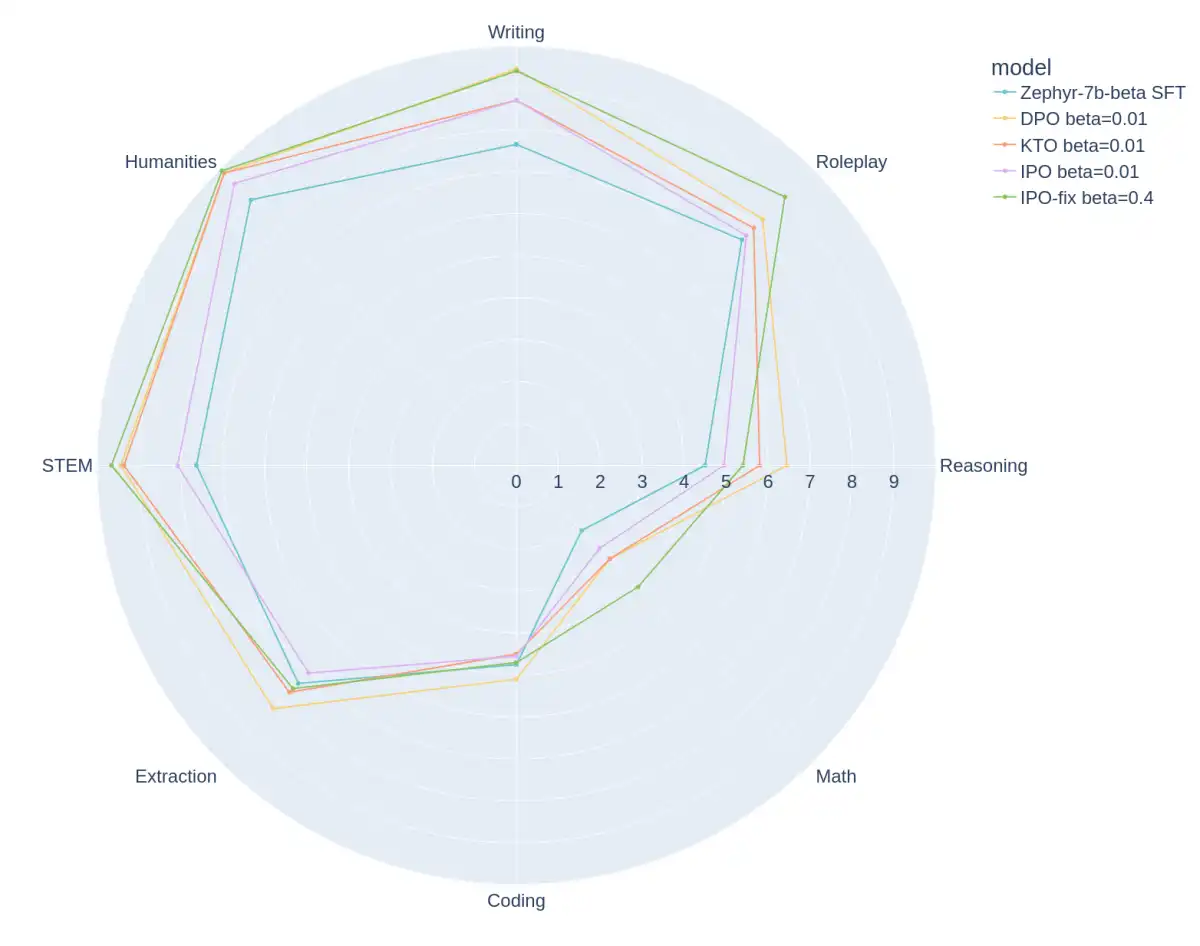
A recent study published on GitHub evaluated three promising methods for aligning LLMs without reinforcement learning: Direct Preference Optimization (DPO), Identity Preference Optimisation (IPO), and Kahneman-Tversky Optimisation (KTO). The researchers conducted experiments on two high-quality 7b LLMs that had undergone supervised fine-tuning but no preference alignment. They found that while one algorithm clearly outshines the others, there are key hyperparameters that must be tuned to achieve the best results.
The study used a dataset of paired preferences and evaluated the models' performance using MT-Bench, a multi-turn benchmark that uses GPT-4 to judge models' performance in eight different categories. The researchers observed that DPO can achieve the highest MT Bench score, but KTO (paired) achieves better results in all but one setting.
Background and Context
Large language models are typically pre-trained through self-supervision, which involves feeding them sentences from vast internet text sources. However, this method doesn't always guide the models to respond in ways that align with human preferences. Traditional methods such as RLHF have been used to fine-tune LLMs, but they involve complex and costly training of multiple models.
RLHF requires human labelers to create preference data to feed the reward model, which can be time-consuming and expensive. An alternative method called RLAIF uses off-the-shelf LLMs as annotators of AI model response preference data, showing that LLM annotation is at least as good as human annotation overall.
Why it Matters
The development of DPO has significant implications for the industry. By eliminating the need for building and tweaking a separate reward model, DPO simplifies the training process and reduces the computational resources required. This makes it an attractive alternative to traditional methods such as RLHF.
DPO also has the potential to improve the performance of LLMs in various tasks, including chatbots and content generation. The study found that DPO can achieve comparable results to RLHF, outperforming KTO in a paired preference setting.
What Comes Next
The researchers plan to continue their work implementing new preference alignment algorithms in TRL and evaluating their performance. They also aim to explore the application of DPO to technical domains where 'bad' data is easy to generate but 'good' data is expensive.
Key Facts
- DPO uses a binary cross-entropy objective to steer models towards producing responses that align with human preferences.
- DPO eliminates the need for building and tweaking a separate reward model, simplifying the training process.
- The study found that DPO can achieve comparable results to RLHF, outperforming KTO in a paired preference setting.
- DPO has the potential to improve the performance of LLMs in various tasks, including chatbots and content generation.
- The researchers plan to continue their work implementing new preference alignment algorithms in TRL and evaluating their performance.