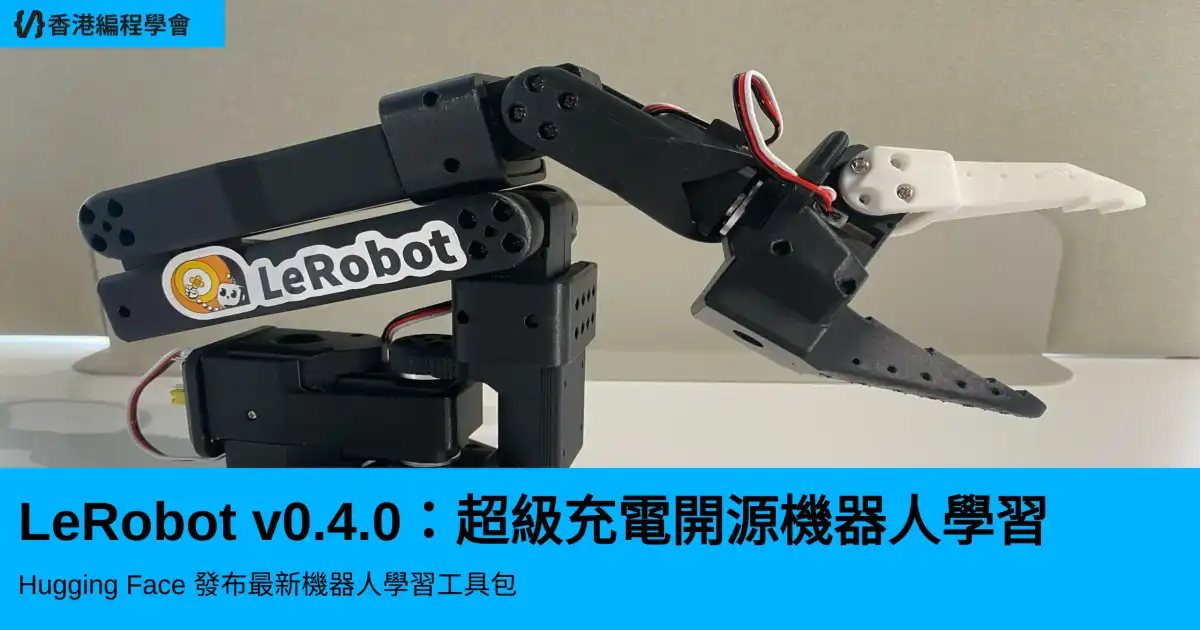
The LeRobot project has released version 0.4.0, a major upgrade to its open-source robot learning platform. The new release includes significant advancements in dataset management, simulation environments, and hardware integration.
What Happened
LeRobot v0.4.0 introduces several key features that aim to make open-source robotics more powerful, scalable, and user-friendly. One of the major updates is the overhaul of the dataset infrastructure with LeRobotDataset v3.0. This new format supports datasets at the OXE-level (> 400GB), enabling unprecedented scalability and efficiency in handling massive datasets like OXE and Droid.
The release also includes a new feature called lerobot-edit-dataset, which provides powerful tools for flexible dataset editing. With this tool, users can delete specific episodes from existing datasets, split datasets by fractions or episode indices, add or remove features with ease, and merge multiple datasets into one unified set.
Background and Context
LeRobot is an open-source robot learning platform that aims to provide models, datasets, and tools for real-world robotics in PyTorch. The project has been gaining traction in the robotics community, with its hardware-agnostic interface standardizing control across diverse platforms.
The LeRobotDataset format is a standardized, scalable dataset format hosted on the Hugging Face Hub, enabling efficient storage, streaming, and visualization of massive robotic datasets. The platform also implements state-of-the-art policies in pure PyTorch, covering Imitation Learning, Reinforcement Learning, and Vision-Language-Action (VLA) models.
Why It Matters to the Industry
The advancements in LeRobot v0.4.0 have significant implications for the adult industry, particularly in terms of scalability and efficiency. With the ability to handle massive datasets and integrate with various hardware platforms, LeRobot can help adult-industry platforms and operators streamline their data collection and model training processes.
Moreover, the new simulation environments and hardware integration features can enable more realistic and diverse training scenarios, which is crucial for developing robust and generalizable models in robotics. This can lead to improved performance and accuracy in real-world applications, such as robotic manipulation and control.
What Comes Next
The release of LeRobot v0.4.0 marks a significant milestone in the project's development. With its new features and advancements, LeRobot is poised to become an even more powerful tool for open-source robotics. The project's community-driven approach and focus on accessibility make it an attractive option for developers and researchers looking to contribute to and benefit from shared datasets and pretrained models.
Key Facts
- LeRobot v0.4.0 introduces LeRobotDataset v3.0, a new dataset format supporting datasets at the OXE-level (> 400GB).
- The release includes a new feature called lerobot-edit-dataset for flexible dataset editing.
- LeRobot now supports LIBERO benchmark and Meta-World simulation environments.
- The platform integrates state-of-the-art policies, including PI0 and PI0.5 models from Physical Intelligence.
- LeRobot v0.4.0 includes a new plugin system for hardware integration and support for Reachy 2 and phone (iOS/Android) teleoperation.