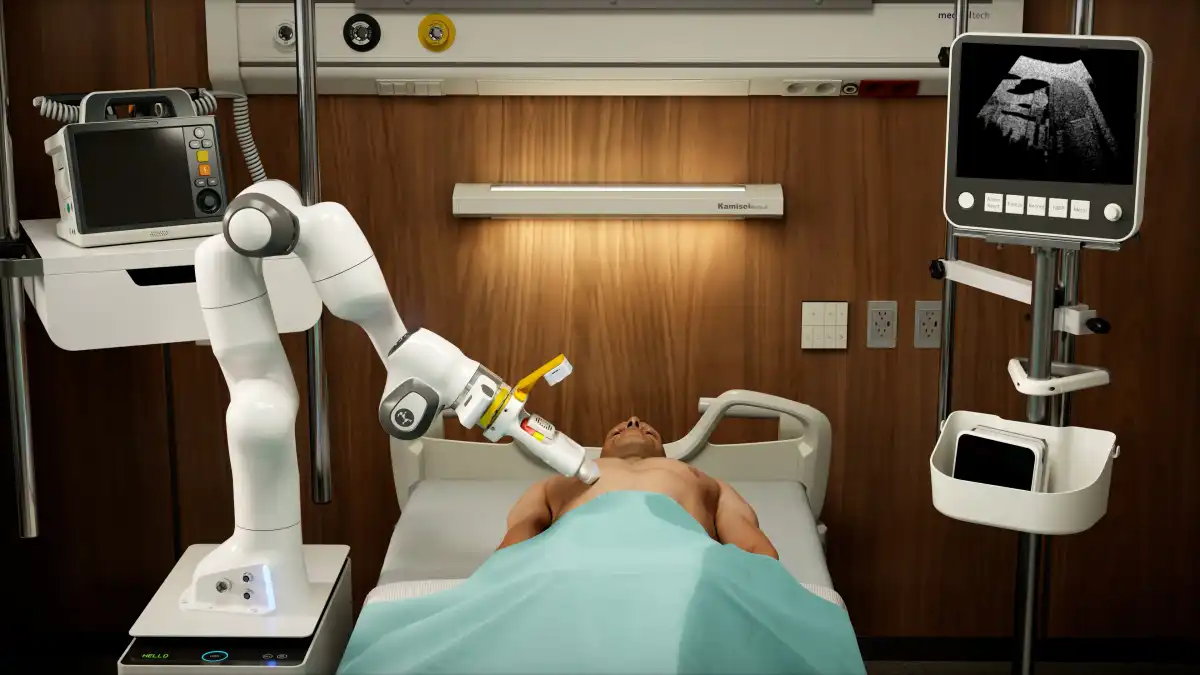
NVIDIA's Isaac platform has made significant strides in healthcare robotics, enabling developers to prototype, simulate, and deploy robotic solutions at a fraction of the time.
Simulation-Driven Workflow Reduces Development Time
A recent article published on HuggingFace explains how a team used NVIDIA's Isaac simulation engine, Isaac Sim, to model a patient-transport robot and validate its kinematics and collision avoidance in a digital twin of a hospital corridor. The team was able to test edge cases such as sudden obstacles or power outages without risking equipment or personnel.
The integration of Isaac Sim with ROS 2 and its physics-based rendering engine allowed for realistic sensor streams, including depth cameras, LiDAR, and force sensors, to be generated on demand. The developers scripted a series of clinical scenarios to expose the robot to uncertainties it would face in a real ward. Machine-learning controllers trained in the virtual environment could be transferred directly to the robot's onboard computer thanks to Isaac's standardized API and model export pipeline.
The simulation also facilitated rapid debugging of perception pipelines, enabling the team to iterate on object detection and pose estimation with near-real-time feedback. After validating the robot in simulation, the team moved to deployment on a physical platform equipped with an NVIDIA Jetson AGX Xavier. The same neural network weights and control scripts were loaded onto the hardware, and real-world trials confirmed that the robot could navigate a hospital maze, recognize and pick up a medication cart, and deliver it to a specified location with less than 5% deviation from the planned path.
Background and Context
NVIDIA's Isaac platform is a unified ecosystem for developing healthcare robots. It offers a range of tools and features that enable developers to prototype, simulate, and deploy robotic solutions at a fraction of the time. The platform includes Isaac Sim, which allows developers to model and simulate complex systems in a virtual environment.
Isaac Sim's integration with ROS 2 and its physics-based rendering engine enables realistic sensor streams to be generated on demand. This allows developers to test and validate their robots in a simulated environment before moving to physical deployment. The platform also includes Isaac SDK, which provides a standardized API for model export and transfer.
The use of NVIDIA's Isaac platform has several benefits for healthcare robotics teams. It enables them to reduce development time from months to weeks by decoupling design from fabrication. This allows teams to test and validate their robots in a simulated environment before moving to physical deployment, reducing the risk of equipment or personnel damage.
Why it Matters to the Industry
162,502 page views