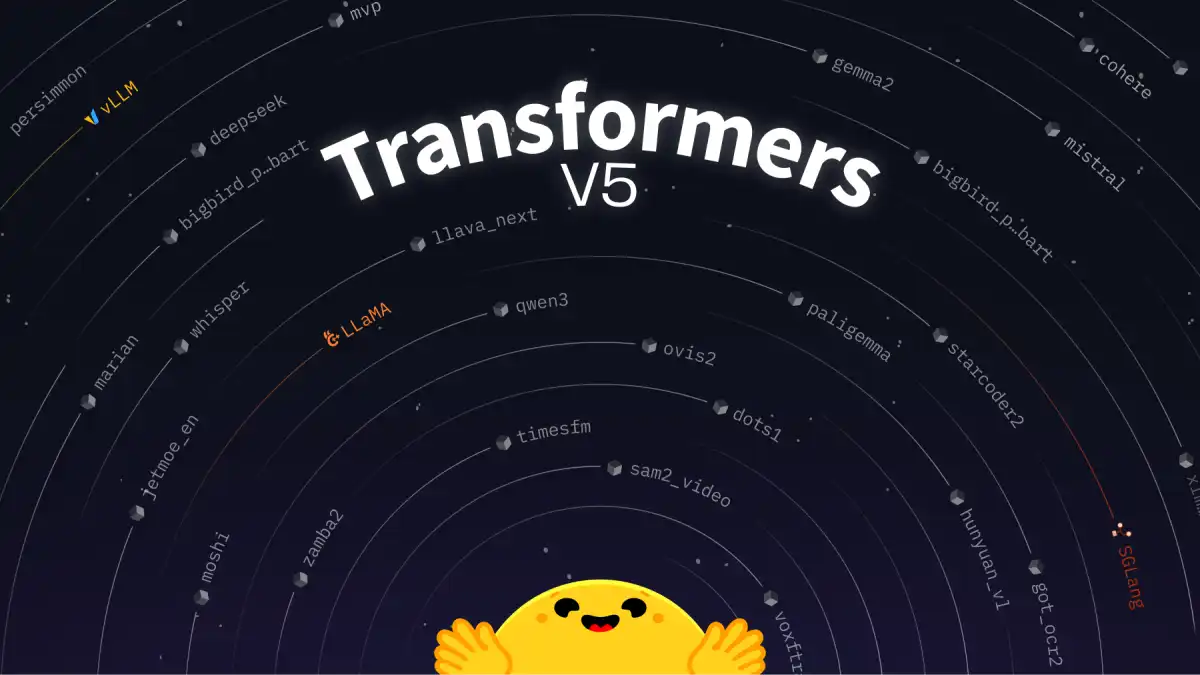
The Hugging Face team has released Transformers v5, a significant update to their popular model-definition library that has seen over 1.2 billion installs and 750,000 community model checkpoints. The new version focuses on simplicity through a modular design for model contributions, code reduction, and a consolidation to PyTorch as the primary backend.
What Happened
The release of Transformers v5 marks a major milestone in the evolution of the library, which has become a cornerstone of the AI ecosystem. The new version is the result of five years of development, during which time it has grown from 40 supported architectures to over 400 and seen a significant increase in daily pip installs, from 20,000/day in v4 to over 3 million.
The team behind Transformers has worked tirelessly to simplify the model contribution process, reduce code complexity, and improve interoperability with other libraries. The modular design of the library allows for easier maintenance, faster integration, and better collaboration across the community.
Background and Context
Transformers is a leading model-definition library in the AI ecosystem, used by hundreds of thousands of projects worldwide. Its popularity can be attributed to its simplicity, flexibility, and wide range of supported architectures. The library has become a "source of truth" for model definitions, with many researchers and developers relying on it as their primary reference.
The growth of Transformers is closely tied to the increasing adoption of AI in various industries. As more organizations seek to leverage AI for their applications, the need for robust and reliable model-definition libraries has grown exponentially. Transformers has risen to meet this demand, becoming a de facto standard in the field.
Why it Matters
The release of Transformers v5 is significant not only because of its technical advancements but also because of its impact on the industry as a whole. The library's focus on simplicity and interoperability will enable developers to build more efficient, scalable, and reliable AI models.
The consolidation of PyTorch as the primary backend for Transformers will further accelerate the adoption of this popular deep learning framework. This move is expected to have a ripple effect throughout the industry, with many organizations likely to follow suit and adopt PyTorch as their preferred deep learning platform.
What Comes Next
The release of Transformers v5 marks the beginning of a new era for the library and its users. The team behind it has outlined several key areas of focus for future development, including continued improvement of inference performance, production readiness, and collaboration with other libraries in the ecosystem.
As the AI industry continues to evolve, it is likely that Transformers will remain at the forefront of innovation. Its modular design, simplicity, and wide range of supported architectures make it an ideal platform for researchers and developers seeking to build cutting-edge AI models.
Key Facts
- Transformers v5 has seen over 1.2 billion installs and 750,000 community model checkpoints.
- The library now supports over 400 architectures, up from 40 in its initial release.
- Daily pip installs have increased from 20,000/day in v4 to over 3 million.
- Transformers has consolidated PyTorch as its primary backend.
- The library's modular design enables easier maintenance, faster integration, and better collaboration across the community.
The release of Transformers v5 is a significant milestone in the evolution of this popular model-definition library. Its focus on simplicity, interoperability, and consolidation to PyTorch as its primary backend will have far-reaching implications for the AI industry as a whole.