Preview · this article is in the editorial review queue and is not yet approved for publish.
Review & approve →
Learn how KV caching speeds up language model generation by eliminating unnecessary computation, reducing quadratic memory/compute requirements. Explore its applications beyond text generation.
KV Caching Technique Speeds Up Autoregressive Language Model Generation
A recent implementation of KV caching from scratch in the
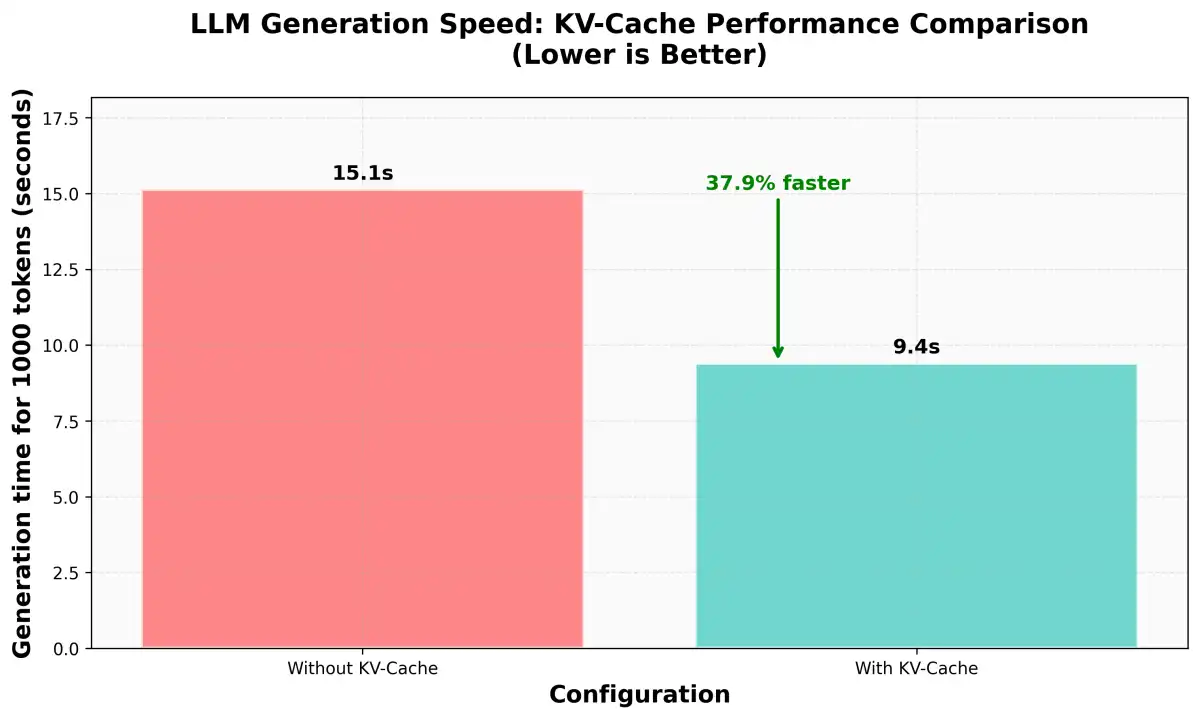
nanoVLM repository has resulted in a 38% speedup in generation. This optimization technique is gaining attention in the field of natural language processing, and its significance extends beyond text generation to other applications such as multimodal models.
KV caching eliminates unnecessary computation during autoregressive generation by storing intermediate key (K) and value (V) computations for reuse during inference. This approach mitigates the inefficiency inherent in sequential generation, where each new prediction requires a full forward pass through all transformer layers, resulting in quadratic memory/compute requirements.
The nanoVLM repository is a small codebase designed to train Vision Language Models with pure PyTorch. The implementation of KV caching in this repository serves as an ideal testbed for understanding the technique's inner workings and its potential applications. By exploring the theory behind KV caching, developers can gain insights into how it can be adapted and integrated into various models.
Background and Context
Autoregressive language models generate text by sampling one token at a time. This sequential process involves processing a given input sequence, predicting the next token, appending it to the sequence, and repeating this process until some stopping criterion is met. Although transformers are internally parallel, each new prediction requires a full forward pass through all transformer layers, leading to computational redundancy.
The attention mechanism within a single attention head plays a crucial role in understanding where KV caching helps. In a simple PyTorch implementation, the key computations involved in self-attention can be visualized as follows:
```python
import torch
input_seq_length = 5
dim_model = 10
input_ids_emb = torch.randn(input_seq_length, dim_model)
W_q = torch.randn(dim_model, dim_model)
W_k = torch.randn(dim_model, dim_model)
W_v = torch.randn(dim_model, dim_model)
Q = input_ids_emb @ W_q
K = input_ids_emb @ W_k
V = input_ids_emb @ W_v
```
This code snippet demonstrates the computation of Q, K, and V for a given input sequence. However, in autoregressive generation, the model recomputes these values at every step, leading to unnecessary computations.
How KV Caching Fixes It
To eliminate this inefficiency, KV caching stores intermediate key (K) and value (V) computations for reuse during inference. This approach involves caching the computed keys and values for each layer after processing the initial prompt. During generation, only the new token's K and V are computed, and they are appended to the cache.
The nanoVLM repository implements KV caching across three key components: the Attention block that uses and updates the KV cache, the Language model that tracks cache per layer, and the Generation loop that separates prefill (the initial pass with the input prompt) and sequential decode phases.
```python
def forward(self, x, cos, sin, attention_mask=None, block_kv_cache=None):
is_prefill = block_kv_cache is None
B, T_curr, C = x.size()
# Project inputs to Q, K, V
q_curr, k_curr, v_curr = project_current_tokens(x)
q, k_rotated = apply_rotary_pos_embd(q_curr, k_curr, cos, sin)
if not is_prefill and block_kv_cache['key'] is not None:
# Append new keys and values to the cache
k = torch.cat([block_kv_cache['key'], k_rotated], dim=2)
v = torch.cat([block_kv_cache['value'], v_curr], dim=2)
else:
# First pass (prefill) — no cache
k, v = k_rotated, v_curr
block_kv_cache = {'key': k, 'value': v}
return attention_output, block_kv_cache
```
This code snippet demonstrates how the Attention block uses and updates the KV cache during generation.
Why It Matters to the Industry
KV caching is a crucial optimization technique for efficient inference in LLMs. Its implementation in the nanoVLM repository has resulted in a 38% speedup in generation, making it an attractive solution for applications requiring fast and efficient text generation. The significance of KV caching extends beyond text generation to other applications such as multimodal models.
What Comes Next
As researchers continue to explore and adapt KV caching for various models, its potential applications will expand. Developers can gain insights into how KV caching can be integrated into their own models by exploring the theory behind it and adapting it to their specific use cases.
Key Facts:
- KV caching speeds up autoregressive language model generation by storing intermediate key (K) and value (V) computations for reuse during inference.
- The nanoVLM repository implements KV caching across three key components: the Attention block, the Language model, and the Generation loop.
- KV caching has resulted in a 38% speedup in generation in the nanoVLM repository.
- Its implementation is an ideal testbed for understanding the technique's inner workings and its potential applications.
- KV caching is a crucial optimization technique for efficient inference in LLMs, making it an attractive solution for applications requiring fast and efficient text generation.