A new large language model-based formal theorem prover, Kimina-Prover Preview 72B, has been introduced as a preview release accompanying the paper "Kimina-Prover Preview: Towards Large Formal Reasoning Models with Reinforcement Learning" (Wang et al., 15 Apr 2025). This system leverages a multi-stage reinforcement learning pipeline to achieve state-of-the-art performance on rigorous formal mathematics benchmarks.
**What Happened**
Kimina-Prover-Preview-72B is built upon the Qwen2.5-72B autoregressive transformer architecture and departs from conventional tree-search or stepwise proof state expansion. Instead, it embraces an internal, open-ended reasoning-driven exploration paradigm. The model is initially fine-tuned in a supervised fashion using a large, curated formal mathematics dataset, followed by reinforcement learning (RL) with a reward provided by the Lean 4 proof assistant.
The RL phase operates as follows:
For each problem, the model samples multiple long-form outputs (k = 8 rollouts per batch).
Each candidate solution's final Lean 4 proof script is checked for correctness using a high-throughput Lean verification backend.
The reward is binary (1 if the proof is accepted by Lean; otherwise 0).
Training leverages a KL-regularized objective:
L(θ)=E(x,y∗)∼D[E(y,z)∼πold[r(x,y,y∗)−τlogZ−τlogπθ(y,z∣x)πold(y,z∣x)]]L(\theta) = \mathbb{E}_{(x,y^*) \sim D} \left[ \mathbb{E}_{(y,z) \sim \pi_{\text{old}}} \left[ r(x, y, y^*) - \tau \log Z - \tau \log\frac{\pi_\theta(y, z|x)}{\pi_{\text{old}}(y, z|x)} ight] ight]L(θ)=E(x,y∗)∼D[E(y,z)∼πold[r(x,y,y∗)−τlogZ−τlogπold(y,z∣x)πθ(y,z∣x)]]
with τ=0.4\tau=0.4τ=0.4 and formatted output constraints ensuring consistent code-reasoning pattern alignment.
**Background and Context**
The development of Kimina-Prover-Preview-72B reflects a significant shift from traditional theorem-proving approaches, emphasizing the integration of informal intuition, formal proof code, and scalable, sample-efficient automated reasoning. This system's architecture, training paradigm, and emergent reasoning style demonstrate a new direction in formal mathematics research.
**Why It Matters to the Industry**
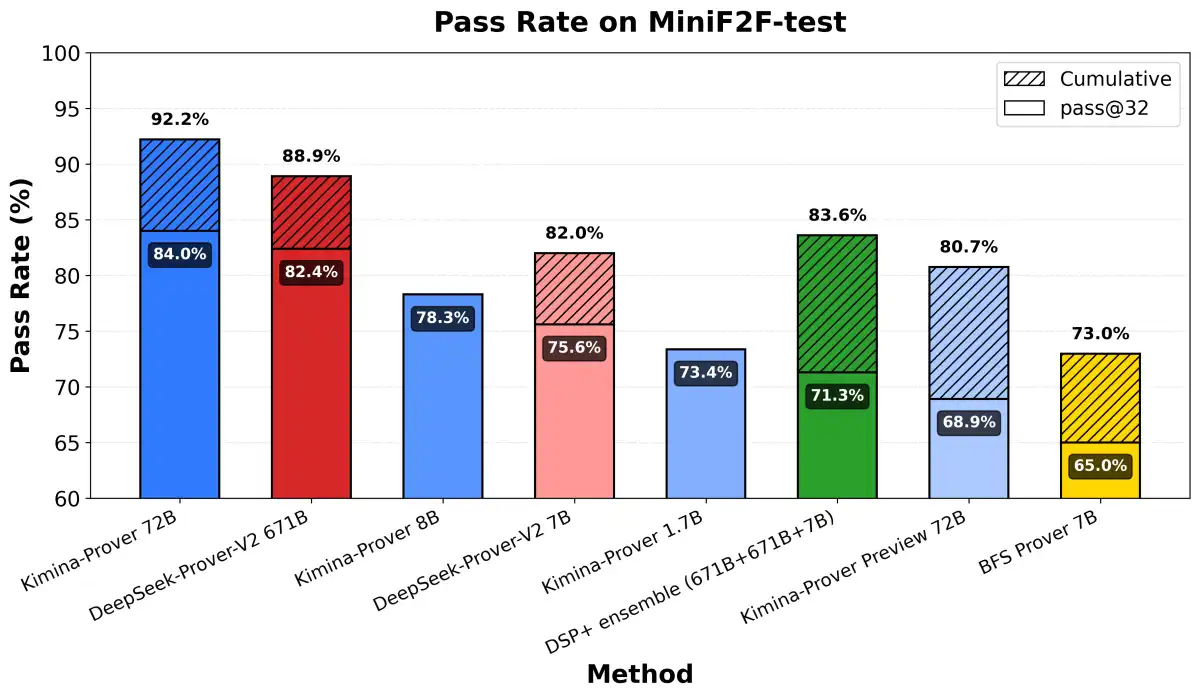
Kimina-Prover-Preview-72B achieves state-of-the-art performance on benchmarks like miniF2F-test, demonstrating scalable and sample-efficient automated formal reasoning. This breakthrough has significant implications for the development of large language models in formal mathematics, enabling more efficient and accurate theorem proving.
**What Comes Next**
The introduction of Kimina-Prover Preview 72B marks a new era in formal mathematics research, with potential applications in various fields such as computer science, mathematics, and artificial intelligence. Future developments will focus on refining the model's architecture and training paradigm to further improve its performance and scalability.
**Key Facts**
- **Model Architecture**: Built upon Qwen2.5-72B autoregressive transformer architecture
- **Training Paradigm**: Multi-stage reinforcement learning pipeline with KL-regularized objective
- **Reward Function**: Binary reward provided by Lean 4 proof assistant
- **Performance**: Achieves state-of-the-art performance on miniF2F-test benchmark
- **Potential Applications**: Formal mathematics, computer science, mathematics, and artificial intelligence