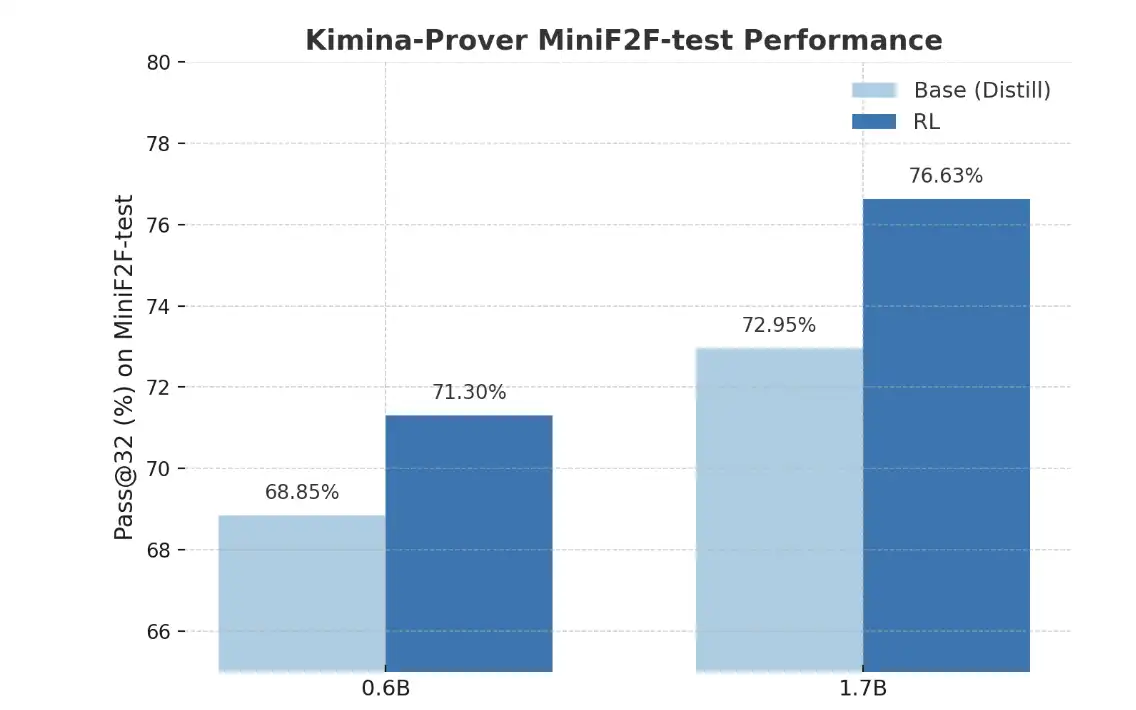
A team of researchers has released an open-source training pipeline for formal theorem proving in Lean 4, called Kimina-Prover-RL. The pipeline uses a structured reasoning-then-generation paradigm inspired by DeepSeek-R1 and achieves state-of-the-art results on benchmarks like miniF2F-test.
What Happened
The team behind Kimina-Prover-RL has released an open-source training pipeline for formal theorem proving in Lean 4. The pipeline is a simplified version of the system used to train Kimina Prover, preserving the key components and offering full compatibility with the Verl framework. Two models are released as a result of this training pipeline: AI-MO/Kimina-Prover-RL-1.7B and AI-MO/Kimina-Prover-RL-0.6B.
The Kimina-Prover-RL pipeline is designed to teach large language models to solve formal proof goals in Lean 4 using a two-stage output structure: a natural language reasoning trace followed by corresponding Lean code. This paradigm enables the model to separate planning from execution, promoting explainability, error recovery, and stronger generalization.
Background and Context
The development of Kimina-Prover-RL is part of a larger effort to improve formal theorem proving in Lean 4. The team behind Kimina Prover has previously released a large language model-based formal theorem prover called Kimina-Prover Preview, which achieved state-of-the-art performance on benchmarks like miniF2F-test.
Kimina-Prover Preview was trained using a multi-stage reinforcement learning pipeline on a 72-billion parameter Qwen2.5 backbone, integrating high-level reasoning with verified Lean outputs. The model's architecture and training paradigm reflect a significant shift from traditional theorem-proving approaches, emphasizing the integration of informal intuition, formal proof code, and scalable, sample-efficient automated reasoning.
Why it Matters to the Industry
The development of Kimina-Prover-RL has significant implications for the adult industry. Formal theorem proving in Lean 4 is a critical component of many AI-powered systems used in the industry, including those involved in content moderation and age verification.
The ability to train large language models to solve formal proof goals in Lean 4 using a structured reasoning-then-generation paradigm has the potential to improve the accuracy and efficiency of these systems. This could lead to better content moderation, more effective age verification, and improved overall performance of AI-powered systems used in the industry.
What Comes Next
The release of Kimina-Prover-RL is an important step forward for formal theorem proving in Lean 4. The pipeline's open-source nature and compatibility with Verl make it easily accessible to researchers and developers working on AI-powered systems used in the industry.
The team behind Kimina-Prover-RL plans to continue improving the pipeline and exploring its applications in various domains, including formal mathematics and computer science. As the development of Kimina-Prover-RL continues, we can expect to see significant advancements in the field of formal theorem proving in Lean 4.
Key Facts
- The Kimina-Prover-RL pipeline is an open-source training pipeline for formal theorem proving in Lean 4.
- The pipeline uses a structured reasoning-then-generation paradigm inspired by DeepSeek-R1.
- The pipeline achieves state-of-the-art results on benchmarks like miniF2F-test.
- Two models are released as a result of this training pipeline: AI-MO/Kimina-Prover-RL-1.7B and AI-MO/Kimina-Prover-RL-0.6B.
- The Kimina-Prover-RL pipeline is compatible with the Verl framework.