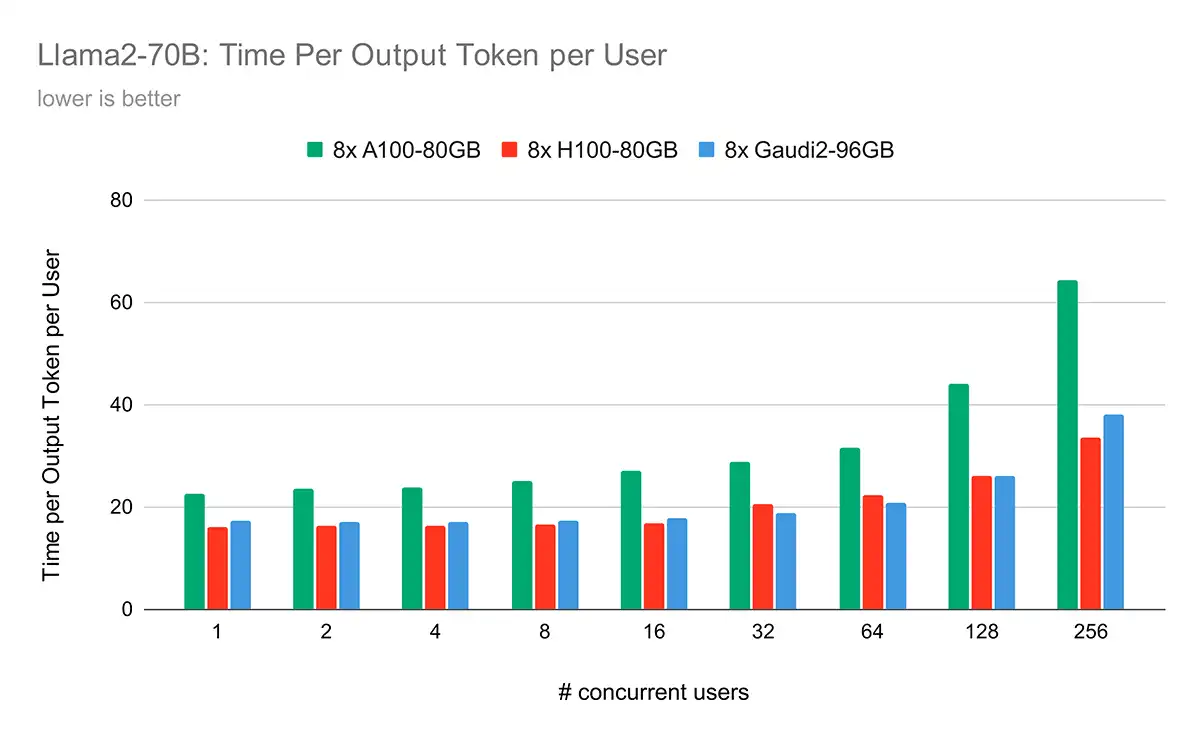
The adult industry's reliance on large language models (LLMs) and other AI technologies has led to a growing need for efficient and cost-effective hardware solutions. Recent developments in LLM training and inference using Intel's Gaudi 2 AI accelerators have shown promising results, with some studies indicating that these accelerators can outperform NVIDIA's H100 in certain tasks.
What Happened
A recent study published on the arXiv preprint server, titled "GFormer: Accelerating Large Language Models with Optimized Transformers on Gaudi Processors," proposes an integrated approach to optimizing LLMs for the Gaudi processor. The authors, led by Chengming Zhang from the University of Houston, developed a method called GFormer that merges sparse and linear attention mechanisms to maximize the computational capabilities of the Gaudi processor's Matrix Multiplication Engine (MME) and Tensor Processing Cores (TPC). This approach aims to optimize LLM inference on Gaudi processors without compromising model quality.
Another study published by Intel, titled "LLM Training and Inference with Intel Gaudi 2 AI Accelerators," demonstrates the performance of the Gaudi 2 accelerator in training and inference tasks. The researchers used the open-source LLM Foundry to train a custom AI model on the Gaudi 2 accelerator and achieved impressive results, including a 1.76x speedup for inference and a 2.92x speedup for fine-tuning compared to NVIDIA's A100.
Background and Context
The adult industry has been at the forefront of adopting AI technologies, particularly LLMs, to improve content creation, moderation, and customer experience. However, the increasing demand for these models has led to a growing need for efficient and cost-effective hardware solutions. The Gaudi 2 accelerator, developed by Intel, is one such solution that has shown promising results in recent studies.
The Gaudi 2 accelerator is built on a 7nm process technology and supports both deep learning training and inference for AI models like LLMs. It features a Matrix Multiplication Engine (MME) and Tensor Processing Cores (TPC), which enable efficient matrix operations and tensor processing. The researchers behind the GFormer study optimized the Gaudi processor's MME and TPC to maximize its computational capabilities, resulting in significant improvements in LLM inference performance.
Why It Matters
The results of these studies have significant implications for the adult industry, which relies heavily on AI technologies like LLMs. The ability to train and infer large language models efficiently and cost-effectively can lead to improved content creation, moderation, and customer experience. Moreover, the Gaudi 2 accelerator's performance in certain tasks outperforming NVIDIA's H100 highlights the potential for Intel's hardware solutions to disrupt the market.
The adult industry's reliance on AI technologies also raises concerns about data privacy and control. The researchers behind the LLM Training and Inference with Intel Gaudi 2 AI Accelerators study emphasized the importance of ensuring that customers can train custom AI models without sacrificing data privacy or control. This highlights the need for more research into developing hardware solutions that prioritize data security and user control.
What Comes Next
The results of these studies demonstrate the potential of Intel's Gaudi 2 accelerator in training and inference tasks. However, further research is needed to fully explore its capabilities and limitations. The adult industry should continue to monitor developments in AI hardware solutions and consider adopting more efficient and cost-effective technologies like the Gaudi 2 accelerator.
Key Facts
- The GFormer study proposes an integrated approach to optimizing LLMs for the Gaudi processor, which merges sparse and linear attention mechanisms to maximize computational capabilities.
- The researchers achieved a 1.76x speedup for inference and a 2.92x speedup for fine-tuning compared to NVIDIA's A100 using the Gaudi 2 accelerator.
- The Gaudi 2 accelerator is built on a 7nm process technology and supports both deep learning training and inference for AI models like LLMs.
- The researchers used the open-source LLM Foundry to train a custom AI model on the Gaudi 2 accelerator, achieving impressive results in training and inference tasks.
- Intel's Gaudi 2 accelerator has shown promising results in recent studies, outperforming NVIDIA's H100 in certain tasks.