The Technology Innovation Institute (TII) in Abu Dhabi has released Falcon Arabic, a 7B parameter Language Model that sets a new benchmark for Arabic NLP. Built on the Falcon 3 architecture, Falcon Arabic is a multilingual model that supports Arabic, English, and several other languages.
What Happened
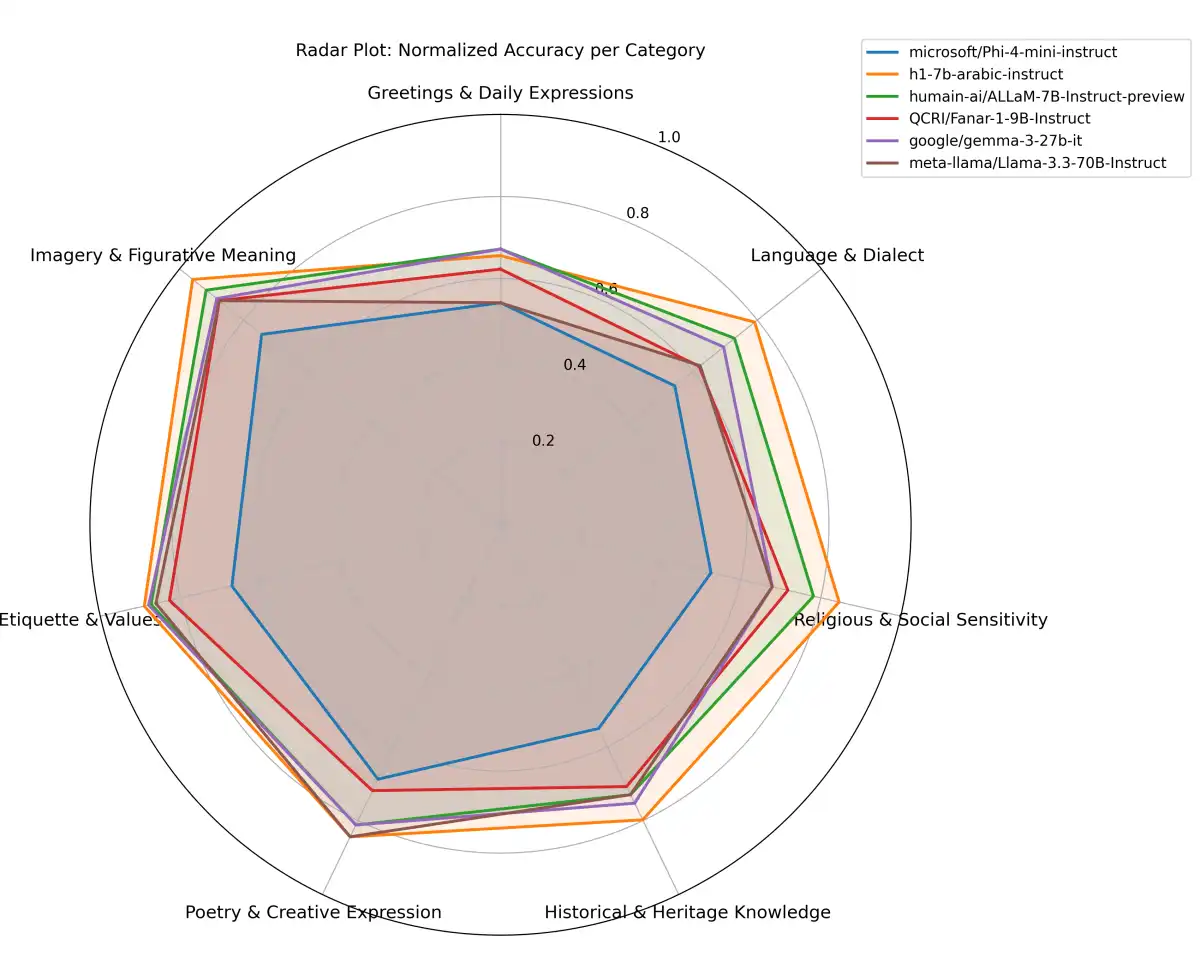
Falcon Arabic was trained exclusively on native data to better capture the cultural and linguistic aspects of the language. The model was also trained on 600 Giga Tokens of Arabic, multilingual, technical data. According to the Open Arabic LLM Leaderboard benchmarks tests conducted by TII, Falcon Arabic outperforms all other regionally available Arabic language models, matching the performance of models up to 10 times its size.
The release of Falcon Arabic marks a significant milestone in the development of Arabic Language Models. The model's advanced language understanding and generation capabilities make it ideal for a wide range of applications, from chatbots and educational tools to content creation, code assistance, and document understanding.
Background and Context
The need for robust Arabic LLMs is essential to ensure Arabic-speaking communities are fully included in the AI revolution. Arabic presents unique challenges due to its morphologically rich, diglossic nature, spanning both Modern Standard Arabic (MSA) and diverse regional dialects. Developing Arabic LLMs that can handle these complexities has been a long-standing challenge for researchers and developers.
The Falcon 3 model family, developed by TII, has earned global recognition for its multilingual strength and open-source approach. Falcon-Arabic builds on this legacy, bringing advanced language understanding and generation to Arabic. By training the model to handle both Modern Standard Arabic and key dialects, Falcon-Arabic fills a critical gap in language technology enabling more natural, intelligent, and inclusive Arabic AI across the Gulf, Middle East, and North Africa.
Why it Matters to the Industry
The release of Falcon Arabic has significant implications for the adult industry. With its advanced language understanding and generation capabilities, Falcon-Arabic can be used to improve chatbots, content creation tools, and other applications that require natural language processing. The model's ability to handle long documents and enable advanced applications like retrieval-augmented generation (RAG) also makes it an attractive solution for industries that require complex content creation.
The industry's growing demand for multilingual support is another key factor driving the development of Falcon Arabic. As the global adult industry continues to expand, the need for models that can handle diverse languages and dialects becomes increasingly important. Falcon-Arabic addresses this need by providing a state-of-the-art model that supports multiple languages, including Arabic.
What Comes Next
The release of Falcon Arabic marks the beginning of a new era in Arabic Language Models. As the industry continues to evolve and demand more advanced language processing capabilities, models like Falcon-Arabic will play an increasingly important role. The future of Arabic AI is bright, and Falcon-Arabic is at the forefront.
Key Facts
- Falcon Arabic is a 7B parameter Language Model that sets a new benchmark for Arabic NLP.
- The model was trained exclusively on native data to better capture the cultural and linguistic aspects of the language.
- Falcon Arabic outperforms all other regionally available Arabic language models, matching the performance of models up to 10 times its size.
- The model's advanced language understanding and generation capabilities make it ideal for a wide range of applications.
- Falcon-Arabic was trained on 600 Giga Tokens of Arabic, multilingual, technical data.