A new benchmark for evaluating Arabic large language models has been introduced by a team of researchers from the UAE, focusing on the Emirati dialect and its nuances. The Alyah benchmark aims to assess how well Arabic LLMs capture the linguistic, cultural, and pragmatic aspects of the Emirati dialect, which is deeply intertwined with local culture, heritage, and history.
What Happened
The team behind the Alyah benchmark has introduced a dataset containing 1,173 samples, all collected manually from native Emirati speakers to ensure linguistic authenticity and cultural grounding. Each sample is formulated as a multiple-choice question with four candidate answers, exactly one of which is correct. Large language models were used to synthetically generate the distractor choices, after which they were reviewed to ensure plausibility and semantic closeness to the correct answer.
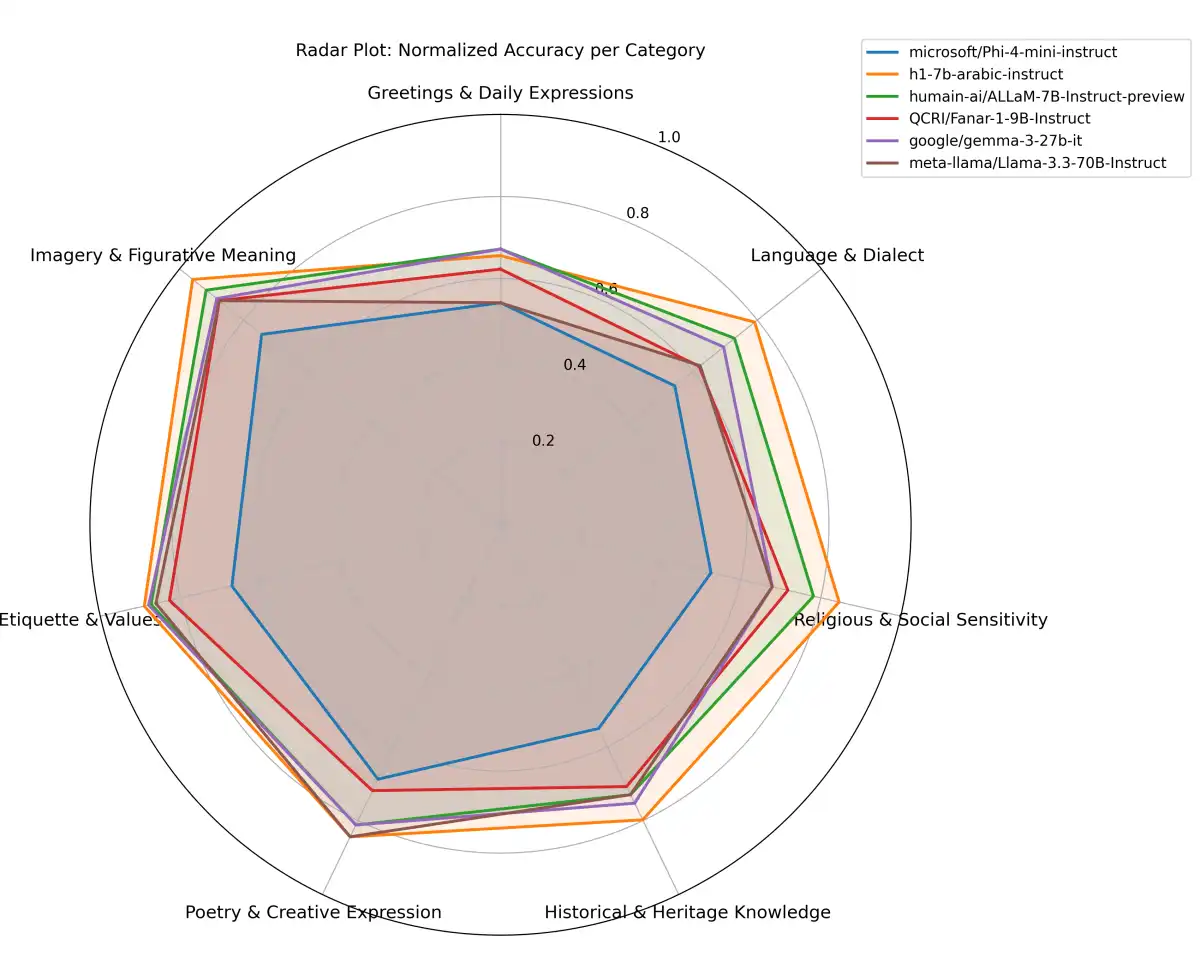
The benchmark covers a wide range of content, including common and uncommon local expressions, culturally grounded greetings, short anecdotes, heritage-related questions, and references to Emirati poetry. The goal is not only to measure correctness but also to understand where models systematically succeed or fail when confronted with authentic Emirati language use.
Background and Context
The rise of large language models has been enabled by the development of robust evaluation benchmarks capable of assessing not only the overall performance on Natural Language Processing (NLP) tasks but also linguistic adaptability. However, existing benchmarks for Arabic LLMs have focused almost exclusively on Modern Standard Arabic, leaving dialectal Arabic largely under-evaluated and under-represented.
A recent benchmark, DialectalArabicMMLU, has extended the MMLU-Redux framework through manual translation and adaptation of 3K multiple-choice question–answer pairs into five major dialects (Syrian, Egyptian, Emirati, Saudi, and Moroccan), yielding a total of 15K QA pairs across 32 academic and professional domains. However, this benchmark still has limitations in terms of its scope and coverage.
Why it Matters to the Industry
The Alyah benchmark is significant for several reasons. Firstly, it addresses the critical gap in evaluating Arabic LLMs' ability to understand and generate dialectal language. Secondly, it provides a more nuanced understanding of the Emirati dialect's complexities and subtleties, which can inform the development of more effective NLP models.
The benchmark's focus on cultural grounding is also noteworthy, as it highlights the importance of considering the cultural context in which language is used. This is particularly relevant for industries that rely heavily on language processing, such as customer service or content moderation, where understanding cultural nuances can be critical to providing effective support or moderating online interactions.
What Comes Next
The introduction of the Alyah benchmark marks an important step forward in evaluating Arabic LLMs' capabilities. However, there are still significant challenges to overcome, particularly in terms of scaling and generalizing the results to other dialects and languages.
To address these challenges, researchers will need to continue developing more comprehensive and nuanced benchmarks that capture the complexities of human language. The Alyah benchmark provides a valuable starting point for this effort, and its introduction is likely to spark further research and innovation in the field of Arabic NLP.
Key Facts
- The Alyah benchmark focuses on the Emirati dialect and its nuances.
- The dataset contains 1,173 samples, all collected manually from native Emirati speakers.
- The benchmark covers a wide range of content, including common and uncommon local expressions.
- The goal is not only to measure correctness but also to understand where models systematically succeed or fail.
- The Alyah benchmark addresses the critical gap in evaluating Arabic LLMs' ability to understand and generate dialectal language.