A recent study has shed light on the phenomenon of "hallucinations" in large language models, where they produce plausible yet incorrect statements instead of admitting uncertainty. The research, published by a team of authors from OpenAI and other institutions, argues that these hallucinations are not mysterious but rather a result of errors in binary classification.
What Happened
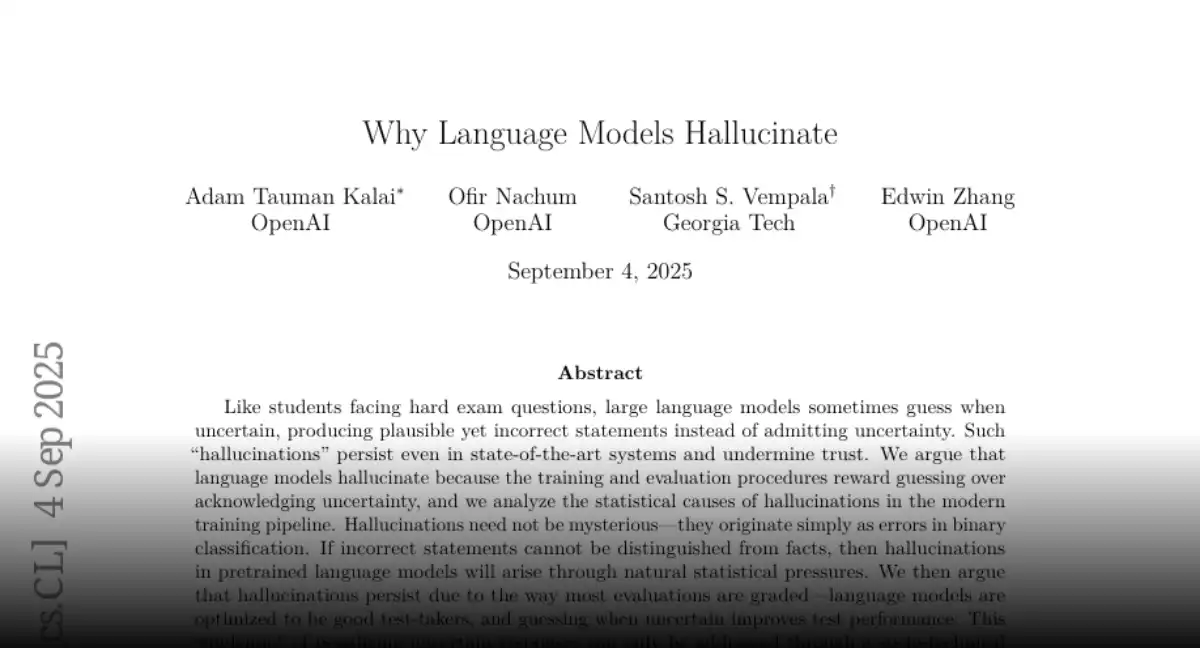
The study, titled "Why Language Models Hallucinate," was submitted to the arXiv repository on September 4, 2025. The authors, Adam Tauman Kalai, Ofir Nachum, Santosh S. Vempala, and Edwin Zhang, analyzed the statistical causes of hallucinations in the modern training pipeline for large language models.
The researchers found that the training and evaluation procedures reward guessing over acknowledging uncertainty, leading to a need for socio-technical changes in benchmark scoring. They argue that if incorrect statements cannot be distinguished from facts, then hallucinations in pretrained language models will arise through natural statistical pressures.
Background and Context
Large language models have become increasingly popular in recent years due to their ability to generate human-like text. However, these models are not immune to errors, and one of the most significant issues is hallucinations. Hallucinations occur when a model produces plausible yet incorrect statements instead of admitting uncertainty.
The authors note that hallucinations persist even in state-of-the-art systems and undermine trust. They argue that language models are optimized to be good test-takers, and guessing when uncertain improves test performance. This "epidemic" of penalizing uncertain responses can only be addressed through a socio-technical mitigation: modifying the scoring of existing benchmarks that are misaligned but dominate leaderboards.
Why it Matters to the Industry
The findings of this study have significant implications for the adult industry, which relies heavily on large language models for tasks such as content moderation and chatbots. The industry has long struggled with issues related to trust and accuracy in AI-generated content, and hallucinations only exacerbate these problems.
Adult-industry platforms and operators must consider the potential consequences of using language models that are prone to hallucinations. If a model produces incorrect statements, it can lead to misinformation, mistrust, and even legal issues. The industry needs to adapt to the limitations of AI technology and develop strategies to mitigate the effects of hallucinations.
What Comes Next
The study's authors propose modifying the scoring of existing benchmarks that are misaligned but dominate leaderboards as a socio-technical mitigation for addressing hallucinations. This change may steer the field toward more trustworthy AI systems.
The industry can learn from this research and adapt its approach to using large language models. By acknowledging the limitations of these models and developing strategies to mitigate the effects of hallucinations, adult-industry platforms and operators can improve trust and accuracy in AI-generated content.
Key Facts
- The study "Why Language Models Hallucinate" was published by a team of authors from OpenAI and other institutions on September 4, 2025.
- The researchers found that the training and evaluation procedures reward guessing over acknowledging uncertainty, leading to hallucinations in large language models.
- Hallucinations persist even in state-of-the-art systems and undermine trust.
- The authors propose modifying the scoring of existing benchmarks as a socio-technical mitigation for addressing hallucinations.
- The study has significant implications for the adult industry, which relies heavily on large language models for tasks such as content moderation and chatbots.