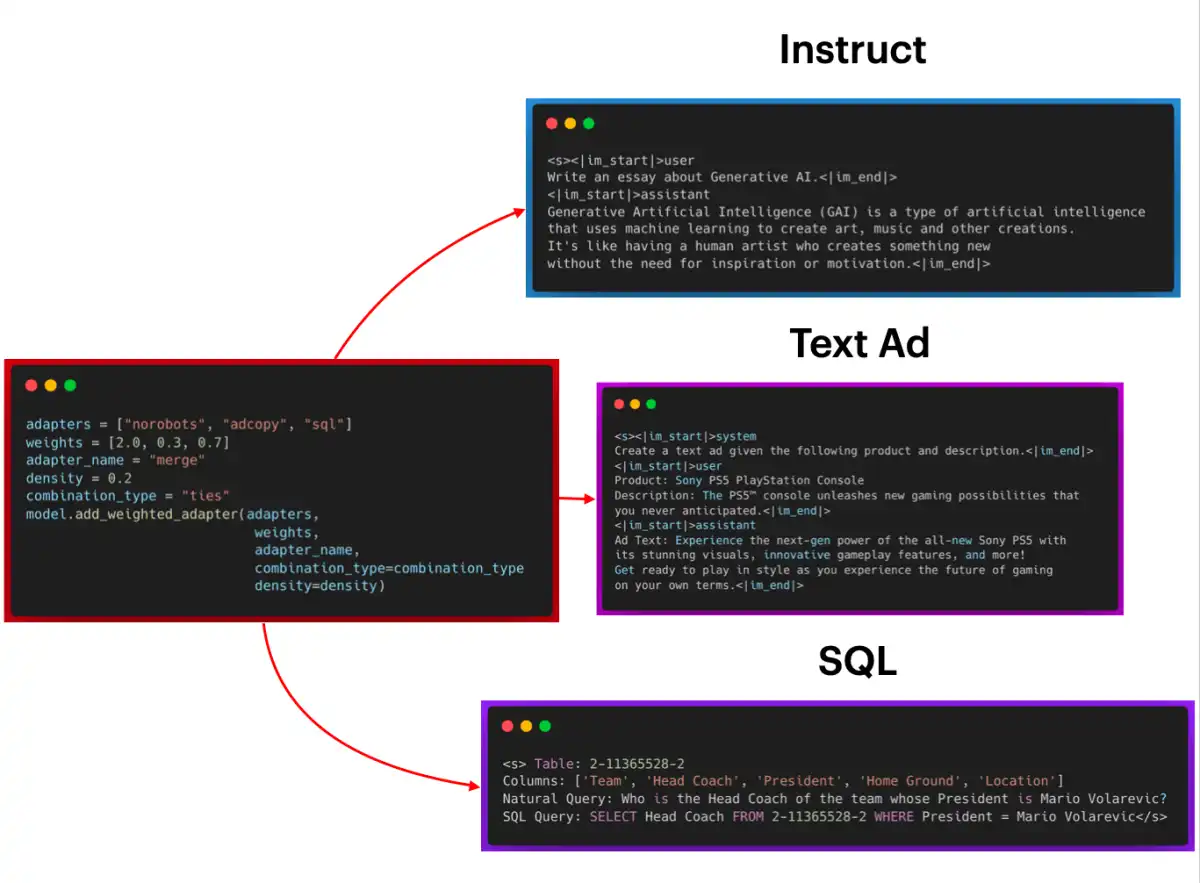
Model merging has become a crucial technique for pushing the performance limits of large language models. Recently, Hugging Face's PEFT (Pre-trained Embeddings for Transformers) has introduced new merging methods specifically designed for LoRA adapters, which are widely used in various applications.
What Happened
The introduction of these new merging methods is a significant development in the field of model merging. According to Hugging Face's blog post, the typical way of model merging involves downloading checkpoints and performing merging using a merge algorithm. However, this process can be memory-intensive and may not be suitable for all applications.
To address this issue, PEFT has developed new merging methods that are tailored specifically for LoRA adapters. These methods include concatenation (cat), linear/task arithmetic (linear), singular value decomposition (svd), ties, and dare. Each of these methods has its own strengths and weaknesses, and they can be used in different scenarios depending on the specific requirements of the application.
Background and Context
Model merging is a technique that involves combining multiple models to create a single, more powerful model. This is achieved by downloading checkpoints from each model and performing merging using a merge algorithm. However, this process can be memory-intensive and may not be suitable for all applications.
The use of LoRA adapters has become increasingly popular in recent years due to their ability to fine-tune large language models on specific tasks without requiring significant computational resources. However, the merging of LoRA adapters presents unique challenges due to varying merging requirements and the need for seamless integration.
Why It Matters
The introduction of new merging methods specifically designed for LoRA adapters is a significant development in the field of model merging. These methods can be used to improve the performance of large language models on specific tasks, such as text-to-image generation and mental health-related queries.
The use of these new merging methods can also help to reduce the memory requirements associated with model merging, making it more suitable for applications where computational resources are limited. Additionally, the introduction of these methods demonstrates Hugging Face's commitment to providing innovative solutions for the development of large language models.
What Comes Next
The introduction of new merging methods specifically designed for LoRA adapters is a significant step forward in the field of model merging. However, there are still many challenges to be addressed in this area, including the need for more efficient and scalable merging algorithms.
Hugging Face has already begun exploring ways to integrate these new merging methods into its popular Diffusers library, which provides a range of tools and resources for developers working with large language models. Additionally, the company is encouraging developers to experiment with these new methods and provide feedback on their performance and usability.
Key Facts
- The introduction of new merging methods specifically designed for LoRA adapters is a significant development in the field of model merging.
- These methods include concatenation (cat), linear/task arithmetic (linear), singular value decomposition (svd), ties, and dare.
- The use of these new merging methods can help to improve the performance of large language models on specific tasks.
- The introduction of these methods demonstrates Hugging Face's commitment to providing innovative solutions for the development of large language models.
- Hugging Face is encouraging developers to experiment with these new methods and provide feedback on their performance and usability.