The adult industry's quest for more efficient and scalable language models has taken a significant leap forward with the introduction of NVIDIA's KVPress toolkit. This innovative solution addresses the memory challenges associated with long-context language models (LLMs) by compressing the Key-Value (KV) Cache, making it possible to handle massive context windows without overwhelming memory resources.
What Happened
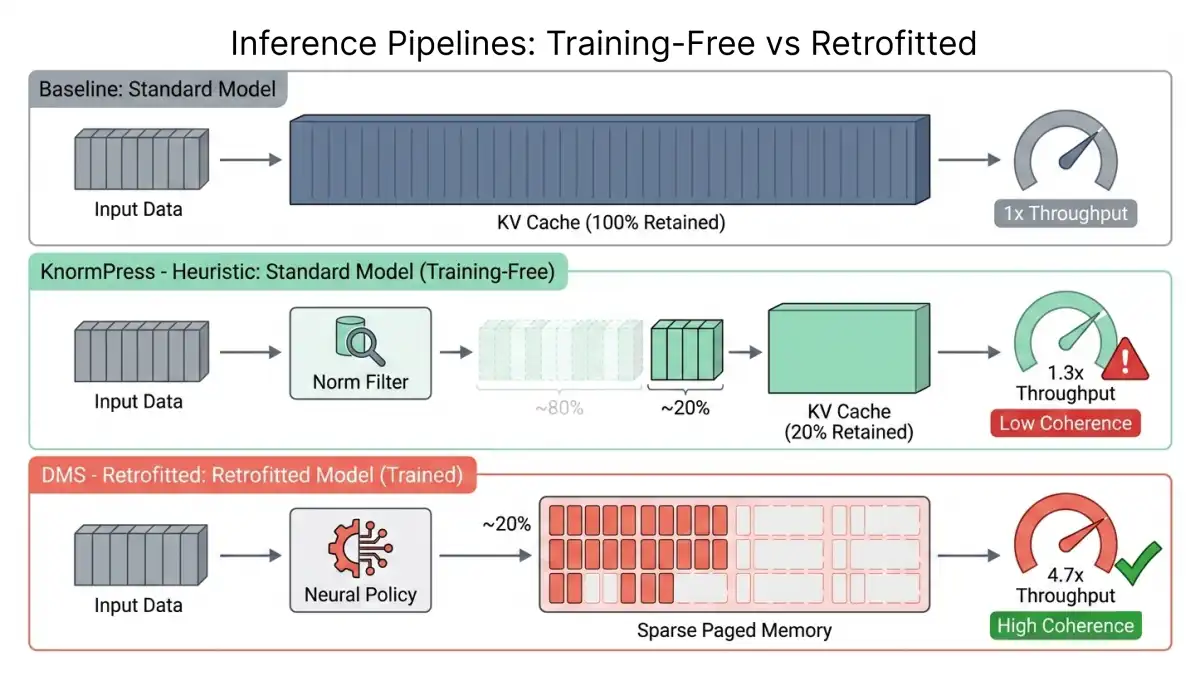
NVIDIA's KVPress is a Python toolkit designed to compress the KV Cache using state-of-the-art techniques. The KV Cache is a critical component of LLMs, storing intermediate results for efficient text generation. However, as context windows grow larger, the KV Cache becomes a significant bottleneck, consuming massive amounts of memory. For instance, Llama 3-70B in bfloat16 precision requires 470GB of memory for a 1M token context, with the KV Cache alone accounting for 70% of this total.
KVPress employs advanced compression algorithms called presses, which dynamically prune less important KV pairs during text generation. For example, KnormPress prunes KV pairs with the lowest key-value norm, while SnapKVPress removes KV pairs associated with low attention weights for future queries. These presses are seamlessly integrated into the attention layers of the model using forward hooks, reducing memory usage without compromising the model's ability to generate coherent and accurate outputs.
Background and Context
The growing context windows of LLMs unlock new possibilities but pose significant memory challenges. Large Language Models like Llama 3-70B are capable of processing up to 1 million tokens in a single request, enabling groundbreaking applications such as in-context retrieval, learning, and extended reasoning. However, these capabilities come at a cost – the KV Cache scales linearly with the context window, consuming massive amounts of memory.
The KV Cache optimizes text generation by storing keys (K) and values (V) from the attention layers, allowing the model to reuse computations instead of recalculating them. While this mechanism is efficient for shorter sequences, it becomes a bottleneck for long contexts. The growing demand for more efficient LLMs has led to the development of compression techniques like KVPress, which addresses the memory challenge by compressing the KV Cache during the critical pre-filling phase.
Why It Matters to the Industry
The introduction of KVPress is a significant breakthrough for the adult industry, where large language models are increasingly being used for tasks such as content generation and moderation. The ability to handle massive context windows without overwhelming memory resources will enable developers to create more efficient and scalable LLMs, reducing costs and improving performance.
KVPress also provides a modular framework for researchers and developers to experiment with and deploy compression methods, making it easier to adapt to changing industry needs. The toolkit's seamless integration into the transformers library ensures that developers can easily integrate KVPress into their existing workflows, minimizing disruption and maximizing efficiency.
What Comes Next
The future of LLMs looks promising with the introduction of KVPress. As researchers and developers continue to explore new compression techniques and applications, we can expect to see even more efficient and scalable models emerge. The adult industry will benefit from these advancements, enabling the creation of more complex and engaging content while reducing costs and improving performance.
Key Facts
- KVPress is a Python toolkit designed to compress the Key-Value (KV) Cache using state-of-the-art techniques.
- The KV Cache scales linearly with the context window, consuming massive amounts of memory for long contexts.
- KVPress employs advanced compression algorithms called presses, which dynamically prune less important KV pairs during text generation.
- KnormPress and SnapKVPress are two examples of presses used in KVPress to compress the KV Cache.
- KVPress provides a modular framework for researchers and developers to experiment with and deploy compression methods.
- The toolkit's seamless integration into the transformers library ensures easy adaptation into existing workflows.