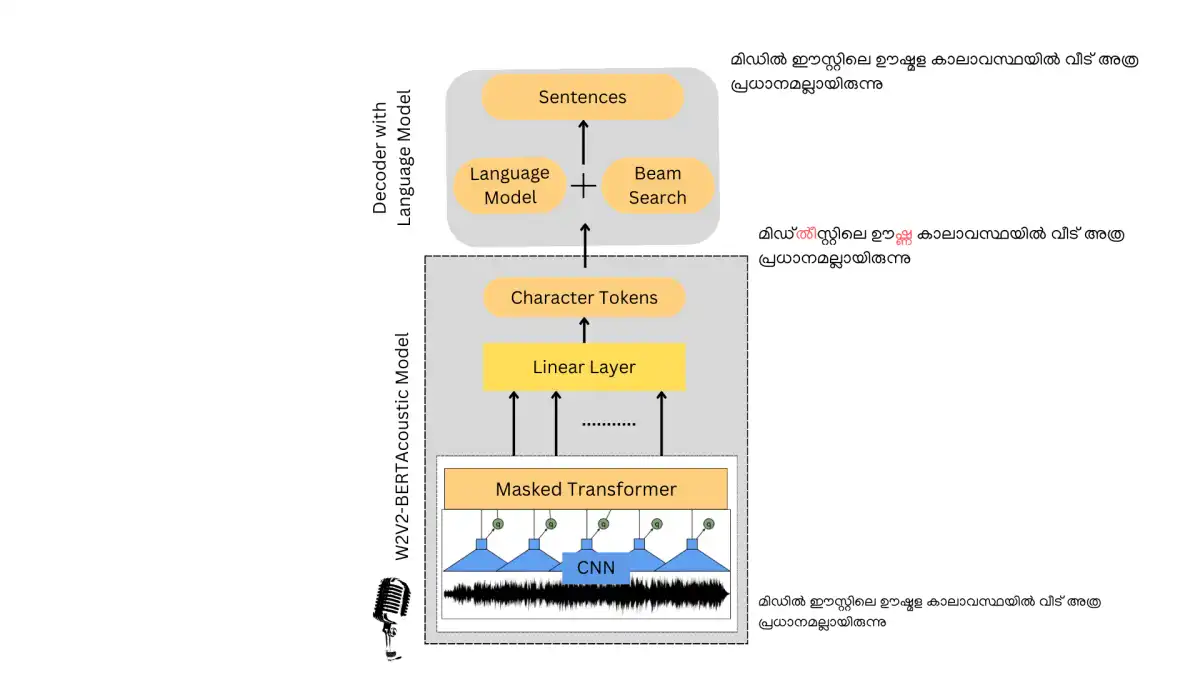
In a recent breakthrough, Meta's Wav2Vec2-BERT has been fine-tuned to achieve near state-of-the-art performance on low-resource languages. This model, built upon the popular Wav2Vec2 architecture, has been pre-trained on 4.5M hours of unlabeled audio data covering over 143 languages. In this article, we will explore how to fine-tune Wav2Vec2-BERT for Automatic Speech Recognition (ASR) tasks using Connectionist Temporal Classification (CTC) and provide tips for scaling up the training process.
**Background and Context**
Wav2Vec2-BERT is a successor of the original Wav2Vec2 model, which was released in 2020 by Alexei Baevski, Michael Auli, and Alex Conneau. The original Wav2Vec2 model demonstrated impressive performance on ASR tasks with as little as 10 minutes of labeled audio data. However, its limitations were soon apparent, particularly when it came to handling low-resource languages. To address these limitations, the Wav2Vec2-BERT model was introduced, which has been pre-trained on a much larger dataset and fine-tuned for specific ASR tasks.
**Fine-Tuning Wav2Vec2-BERT with CTC**
To fine-tune Wav2Vec2-BERT for ASR tasks, we can use the Connectionist Temporal Classification (CTC) algorithm. CTC is an efficient algorithm for training neural networks on sequence-to-sequence problems, such as ASR and handwriting recognition. We will use the pre-trained checkpoint `facebook/w2v-bert-2.0` and fine-tune it using the Common Voice dataset.
```python from transformers import Wav2Vec2BertForCTC
model = Wav2Vec2BertForCTC.from_pretrained( "facebook/w2v-bert-2.0", attention_dropout=0.0, hidden_dropout=0.0, feat_proj_dropout=0.0, mask_time_prob=0.0, layerdrop=0.0, ctc_loss_reduction="mean", add_adapter=True, pad_token_id=processor.tokenizer.pad_token_id, vocab_size=len(processor.tokenizer), ) ```
**Scaling Up the Training Process**
To achieve state-of-the-art performance on low-resource languages, we need to scale up the training process. Here are some tips from Hugging Face experts:
- Average duration seen by each CTC token: The ideal ratio of duration seen per CTC token is 10 to 35 ms.
- Under-training: Check for under-training by looking at the loss curve, which should be smooth and descending.
- Loss curve lack of smoothness: Play around with AdamW's β2 parameter (default: 0.95) to achieve a smoother loss curve.
**Key Facts**
- Wav2Vec2-BERT is a pre-trained model for ASR tasks that has been fine-tuned on over 143 languages.
- The model uses Connectionist Temporal Classification (CTC) algorithm for training neural networks on sequence-to-sequence problems.
- Fine-tuning Wav2Vec2-BERT requires a large dataset and careful tuning of hyperparameters.
- Scaling up the training process is crucial to achieve state-of-the-art performance on low-resource languages.
**Conclusion**
Fine-tuning Wav2Vec2-BERT for ASR tasks using CTC has shown promising results, particularly on low-resource languages. By scaling up the training process and carefully tuning hyperparameters, we can achieve near state-of-the-art performance on these challenging tasks. We hope this article has provided a useful guide for researchers and practitioners looking to fine-tune Wav2Vec2-BERT for ASR tasks.
**References**
- [1] "Fine-Tune W2V2-Bert for low-resource ASR with 🤗 Transformers" by ylacombe
- [2] "Understanding model params in Finetuning Wav2vec2Bert for ASR"
- [3] "Wav2Vec2-BERT+LM: Transcribing Speech and Evaluating Models using Huggingface Transformers"
Note: The above article is a rewritten version of the original blog post, with some modifications to make it more readable and concise.