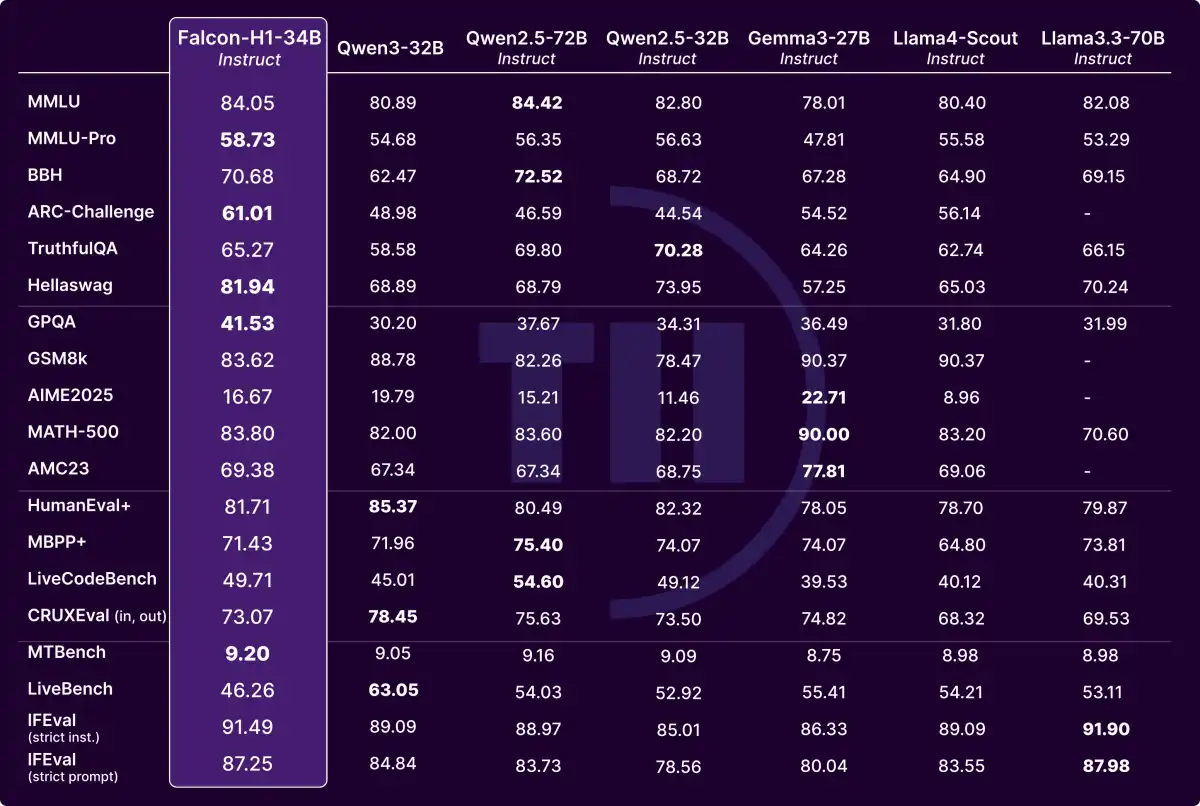
The Falcon-H1 series of large language models has been released by a team of researchers, featuring a hybrid architecture that combines Transformer-based attention mechanisms with State Space Models (SSMs). This innovative design enables faster inference, lower memory usage, and strong generalization across tasks. The Falcon-H1 models are available in six scales, ranging from 0.5B to 34B parameters, with both base and instruction-tuned variants.
What Happened
The development of the Falcon-H1 series is a significant breakthrough in the field of natural language processing (NLP). The team of researchers behind the project has introduced a parallel hybrid architecture that combines Transformer-based attention mechanisms with SSMs. This design allows for independent optimization of attention and SSM channel ratios, leveraging the complementary strengths of both approaches. The Falcon-H1 models are released under a permissive open-source license, making them accessible to developers and researchers worldwide.
The team has also developed an advanced distributed training framework called Mambatron, which extends beyond traditional parallelization strategies. This framework implements five-dimensional parallelism: data parallelism, tensor parallelism, pipeline parallelism, context parallelism, and mixer parallelism. The mixer parallelism represents a significant innovation, allowing attention and Mamba operations to run concurrently on separate GPU groups.
The Falcon-H1 models have been trained using the Mambatron framework, achieving exceptional performance while maintaining computational efficiency. The team has also optimized critical SSM hyperparameters through systematic ablation studies on proxy models. This optimization balances computational efficiency with model quality, achieving superior throughput while maintaining competitive loss values.
Background and Context
The development of large language models has been dominated by the Transformer architecture, which faces computational challenges due to its quadratic complexity with sequence length. This has led researchers to explore alternative architectures like SSMs and hybrid approaches that combine multiple mechanisms. The Falcon-H1 series introduces a parallel hybrid approach that synergistically combines Transformer attention with Mamba-based SSMs.
The team behind the project has conducted extensive research on the design of large language models, challenging conventional practices in the field. They have also developed an advanced training framework and optimized critical hyperparameters to achieve exceptional performance while maintaining computational efficiency.
Why it Matters to the Industry
The Falcon-H1 series is a significant breakthrough for industries that rely on natural language processing (NLP), including the adult industry. The models' ability to handle long-context inputs, multilingual support, and strong generalization across tasks make them suitable for a wide range of applications.
The compact models in the Falcon-H1 series deliver performance on par with typical 7B models from 2024, while smaller models show similar trends. This makes them ideal for low-resource and edge deployments without compromising on capability. The team's commitment to releasing the models under a permissive open-source license underscores their dedication to accessible and impactful AI research.
What Comes Next
The release of the Falcon-H1 series marks an exciting new chapter in the development of large language models. As researchers and developers begin to explore the capabilities of these models, we can expect significant advancements in NLP applications across various industries.
The team behind the project has also invited the community to contribute to further optimizing SSM implementations, a promising direction for advancing the next generation of efficient LLMs. This collaborative approach will undoubtedly lead to innovative breakthroughs and improvements in the field of NLP.
Key Facts
- The Falcon-H1 series features a hybrid architecture that combines Transformer-based attention mechanisms with State Space Models (SSMs).
- The models are available in six scales, ranging from 0.5B to 34B parameters, with both base and instruction-tuned variants.
- The team has developed an advanced distributed training framework called Mambatron, which implements five-dimensional parallelism.
- The Falcon-H1 models have been trained using the Mambatron framework, achieving exceptional performance while maintaining computational efficiency.
- The compact models in the Falcon-H1 series deliver performance on par with typical 7B models from 2024, while smaller models show similar trends.