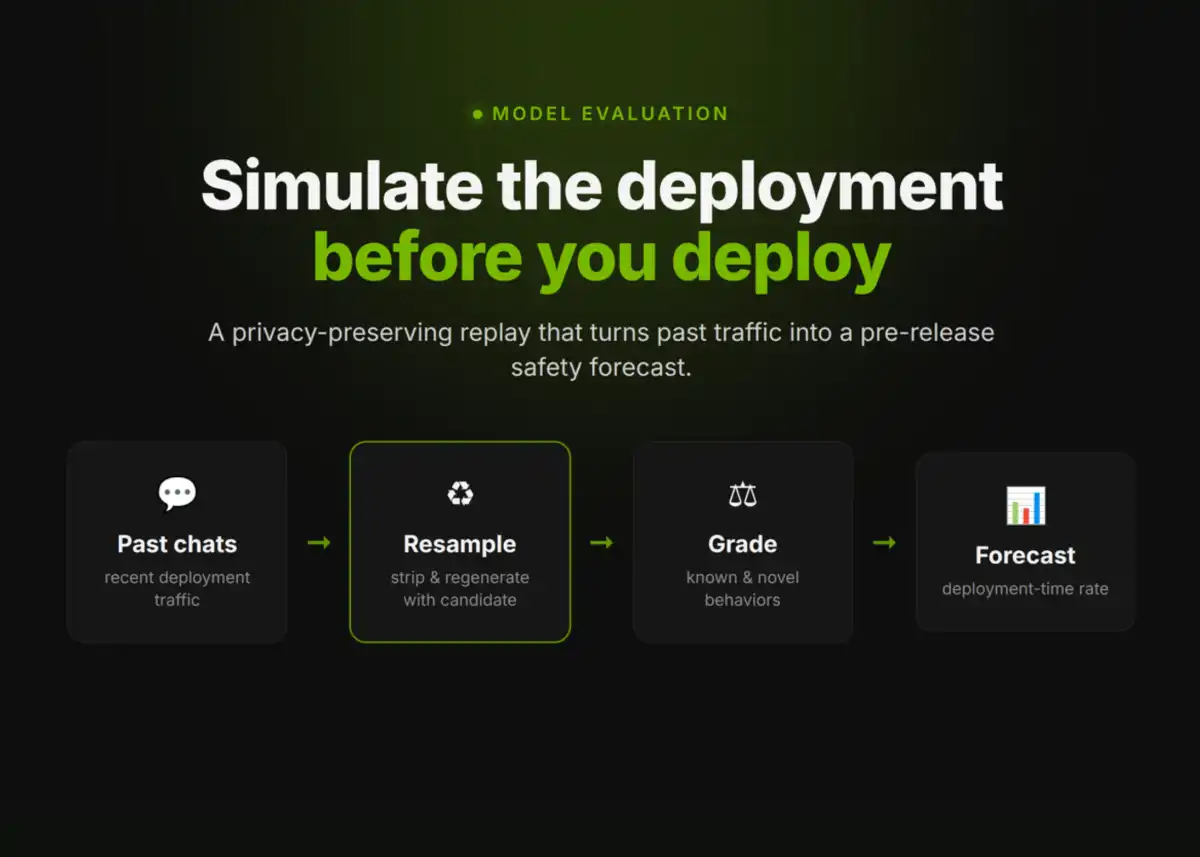
OpenAI has introduced a new methodology called Deployment Simulation to predict AI model behavior before release. This approach simulates deployment using historical, real-world conversation data, ensuring that safety and performance metrics are validated before a single user interacts with the new version.
What Happened
OpenAI published two research articles on its new pre-deployment safety method called Deployment Simulation. The idea is straightforward: before a model ships, simulate its deployment first by replaying past conversations through the new candidate model and studying how it behaves in realistic contexts.
The approach uses real-world conversations to estimate how a model may behave after release and uncover issues that traditional evaluations can miss. OpenAI already runs focused checks and red team exercises ahead of updates, but Deployment Simulation adds another check to confirm that each fresh version keeps the same core functions and abilities as the one before it.
According to the articles, OpenAI uses recent de-identified user conversations, removes the original response, and lets a new model generate its own answer to the same prompt. Automated reviewers analyze those outputs to identify behaviors that standard evaluations may miss.
Background and Context
The transition from a controlled laboratory environment to a live production setting remains one of the most volatile phases in the lifecycle of Large Language Models (LLMs). Developers often find that benchmarks like MMLU or HumanEval do not fully capture how a model will respond to the unpredictable nuances of human interaction.
Traditional LLM evaluation relies on static datasets, which suffer from several limitations. They lack contextual depth, may be contaminated with data seen during training, and can miss rare but critical safety failures that only emerge under specific edge cases.
Deployment Simulation addresses these issues by using a "replay" mechanism. Instead of asking a model to solve a math problem, the simulation puts the model in the shoes of a production instance, feeding it actual anonymized prompts from previous sessions to see if the new model version improves or degrades the user experience.
Why It Matters
The introduction of Deployment Simulation is significant for several reasons. Firstly, it provides a more accurate prediction of AI model behavior before release, reducing the risk of regression and ensuring that updates behave as expected in specific domains.
Secondly, this approach can help improve production readiness and reduce unexpected behavior after release. By simulating deployment using historical conversation data, developers can identify potential issues early on and make necessary adjustments before deploying the model to production.
Lastly, Deployment Simulation has implications for the adult industry, where AI models are increasingly being used to generate content and interact with users. The ability to predict and mitigate potential risks associated with these models is crucial in maintaining a safe and reliable user experience.
What Comes Next
The introduction of Deployment Simulation marks an important step forward in the development of Large Language Models. As this technology continues to evolve, we can expect to see more sophisticated approaches to predicting AI model behavior before release.
OpenAI's methodology has already shown promising results, and it is likely that other companies will follow suit in adopting similar approaches. The industry as a whole stands to benefit from the increased focus on pre-deployment safety and performance metrics.
Key Facts
- Deployment Simulation: A new methodology introduced by OpenAI to predict AI model behavior before release, using historical real-world conversation data.
- Simulation Process: The approach involves replaying past conversations through the new candidate model and studying how it behaves in realistic contexts.
- Benefits: Deployment Simulation can improve production readiness, reduce unexpected behavior after release, and provide a more accurate prediction of AI model behavior before release.
- Implications for the Adult Industry: The ability to predict and mitigate potential risks associated with AI models is crucial in maintaining a safe and reliable user experience.
- OpenAI's Methodology: Has already shown promising results, and it is likely that other companies will follow suit in adopting similar approaches.
- Industry-Wide Benefits: The increased focus on pre-deployment safety and performance metrics stands to benefit the industry as a whole.