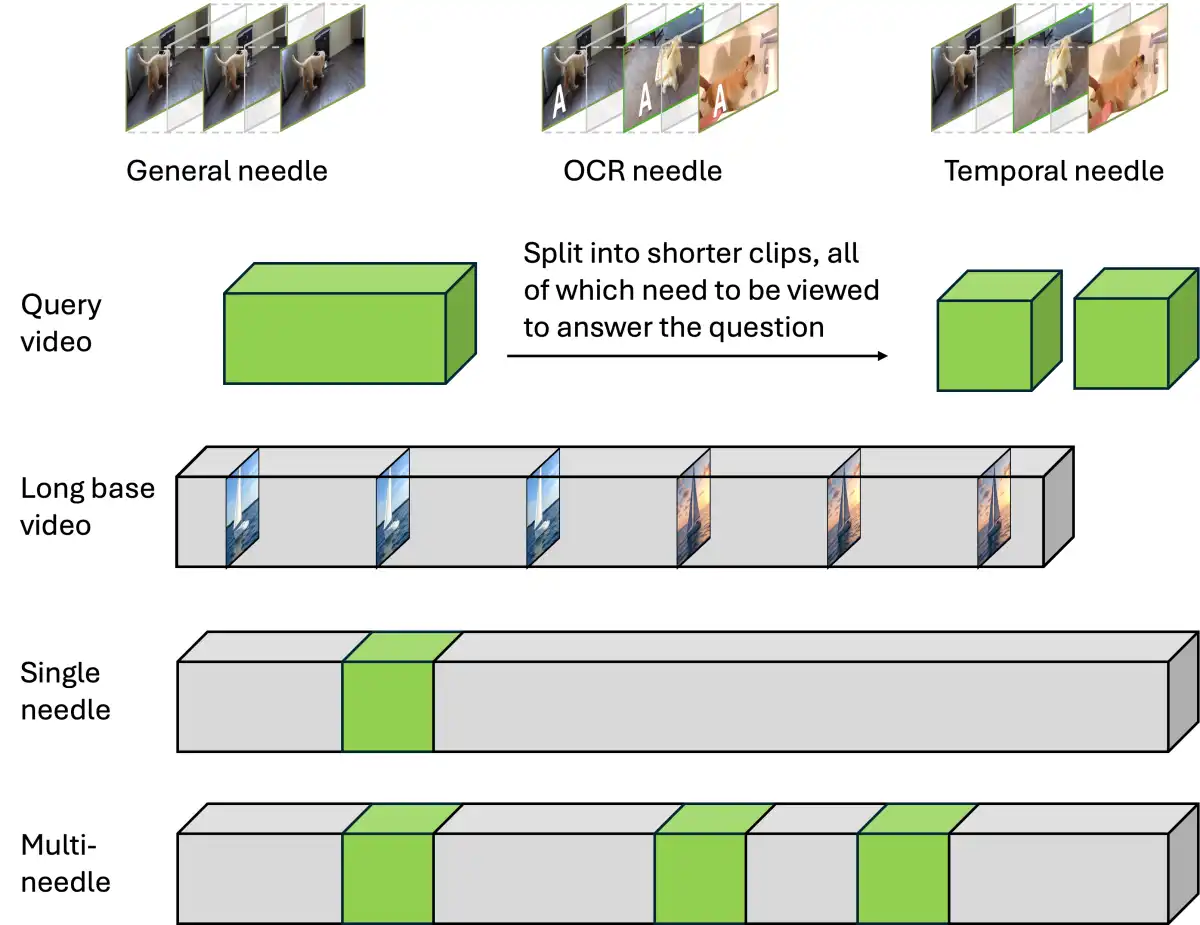
A new open-source benchmark called TimeScope has been released to evaluate how well vision-language models (VLMs) understand long videos. The benchmark inserts short video clips, or "needles," into base videos ranging from 1 minute to 8 hours and assesses three skills: localized retrieval, information synthesis, and fine-grained temporal perception.
What Happened
TimeScope is an open-source benchmark designed to measure the performance of VLMs on long video understanding tasks. The benchmark was developed by researchers at Stanford University and Hugging Face, a company that specializes in natural language processing (NLP) and multimodal AI. TimeScope evaluates three skills: localized retrieval, information synthesis, and fine-grained temporal perception.
Localized retrieval involves identifying specific events or objects within a video. Information synthesis requires the model to gather and order details from multiple points across the timeline. Fine-grained temporal perception assesses the model's ability to analyze motion and events in short video clips.
Background and Context
Recent advances in multimodal AI have produced models claiming to understand hour-long videos. However, these claims require a closer look: do these models truly demonstrate understanding of the sequence of events? Are they limited to surface-level retrieval or recognition?
Text benchmarks such as HELM and RULER have exposed the fragility of long-context claims, showing that models often struggle when tasks demand more than simple retrieval. In the video domain, however, we're still playing catch-up.
Why It Matters to the Industry
The adult industry relies heavily on VLMs for content moderation, age verification, and other applications. However, these models are often trained on short videos or images and struggle with long-form video understanding. TimeScope's evaluation of localized retrieval, information synthesis, and fine-grained temporal perception is crucial for the development of more robust VLMs.
The benchmark's findings have significant implications for the industry. For example, model size isn't everything: Qwen 2.5-VL 3B and 7B, as well as InternVL 2.5 models at 2B, 4B, and 8B parameters, exhibit nearly indistinguishable long-video curves to their smaller counterparts.
What Comes Next
The TimeScope benchmark is now available on Hugging Face, allowing researchers and developers to evaluate the performance of VLMs on long video understanding tasks. The benchmark's findings have significant implications for the development of more robust VLMs in the adult industry.
Key Facts
- TimeScope is an open-source benchmark designed to measure the performance of VLMs on long video understanding tasks.
- The benchmark evaluates three skills: localized retrieval, information synthesis, and fine-grained temporal perception.
- Model size isn't everything: Qwen 2.5-VL 3B and 7B, as well as InternVL 2.5 models at 2B, 4B, and 8B parameters, exhibit nearly indistinguishable long-video curves to their smaller counterparts.
- Gemini 2.5-Pro is the only model that maintains strong accuracy on videos longer than one hour.
- TimeScope's evaluation of localized retrieval, information synthesis, and fine-grained temporal perception is crucial for the development of more robust VLMs in the adult industry.
The release of TimeScope marks an important step forward in the development of more robust VLMs. As the adult industry continues to rely on these models for content moderation, age verification, and other applications, it's essential that we understand their limitations and capabilities.