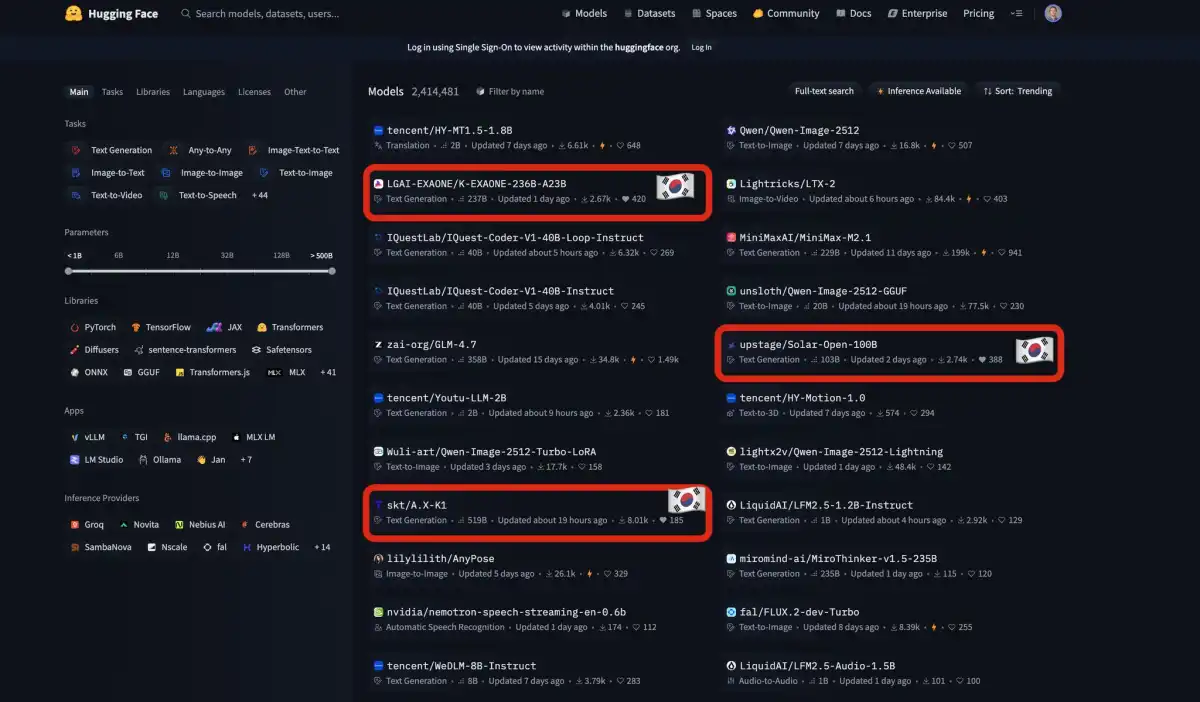
The open-source AI landscape has undergone significant changes over the past year, with a surge in growth and adoption of open-source models on Hugging Face. According to the latest report from Hugging Face, the platform reached 13 million users, 2+ million public models, and 500,000+ public datasets in 2025, signaling a much larger and more active builder ecosystem.
The growth is broad but attention is highly concentrated, with about half of models having fewer than 200 total downloads, while the top 200 models account for nearly 50% of all downloads. The ecosystem remains huge, but most usage still clusters around a small number of winners.
China's Dominance
One of the most significant shifts in the landscape has been China's wholesale embrace of open-source AI. Chinese models now account for 41% of all downloads, surpassing the US. This is a dramatic change from previous years, where the US was the dominant force in open-source model adoption on Hugging Face.
China's strategic shift to open source has been driven by the viral release of DeepSeek's R1 model in January 2025. The number of competitive Chinese organizations releasing models and the number of repositories on Hugging Face skyrocketed, with Baidu going from zero releases on the Hub in 2024 to over 100 in 2025.
Individual Creators vs Organizations
The growth of open-source AI has also led to a shift in power dynamics within the ecosystem. Independent developers have risen from 17% to 39% of all downloads, driven by people adapting, quantizing, and redistributing models. This is a significant change from previous years, where industry labs dominated the landscape.
Individual creators are now playing a more prominent role in shaping the open-source AI ecosystem. They are creating derivative models, fine-tuning existing models, and building new applications using open-source tools. This democratization of AI development has opened up new opportunities for innovation and creativity within the industry.
The Rise of Smaller, Deployable Models
Despite the growth of larger models, smaller models are still preferred by developers. The median size of downloaded open models rose from 827M parameters in 2023 to 20.8B in 2025, driven largely by quantization and mixture-of-experts architectures. However, the mean size increased significantly, indicating that high-end LLM users are pulling up the mean while underlying small-model usage remains stable.
The preference for smaller models is driven by practical considerations such as cost, latency, and hardware availability. Smaller models are cheaper to run, easier to deploy, and more accessible to developers working with limited resources. This trend highlights the importance of usability in everyday adoption, where raw scale is no longer the only consideration.
Specialized Communities: Robotics Revolution
The open-source AI ecosystem has also seen a surge in specialized communities, particularly in robotics. Robotics datasets grew from 1,145 in 2024 to 26,991 in 2025, becoming the largest category on Hugging Face. This growth is driven by the increasing demand for autonomous systems and robotic applications.
The rise of specialized communities has also led to a shift towards more domain-specific models. Developers are creating models optimized for specific tasks, such as robotics, natural language processing, and computer vision. This trend highlights the importance of specialization in AI development, where models are tailored to meet the needs of specific industries or applications.
Key Facts
- Hugging Face reached 13 million users, 2+ million public models, and 500,000+ public datasets in 2025.
- Chinese models now account for 41% of all downloads on Hugging Face, surpassing the US.
- Independent developers have risen from 17% to 39% of all downloads, driven by people adapting, quantizing, and redistributing models.
- The median size of downloaded open models rose from 827M parameters in 2023 to 20.8B in 2025.
- Robotics datasets grew from 1,145 in 2024 to 26,991 in 2025, becoming the largest category on Hugging Face.
Looking Ahead: The Future of Open AI
The open-source AI ecosystem continues to evolve rapidly, driven by the growth of specialized communities and the increasing demand for domain-specific models. As the industry continues to mature, we can expect to see more innovation and creativity in AI development.
The shift towards open source has also led to a greater emphasis on usability and accessibility. Developers are creating models that are easier to deploy, more accessible to developers working with limited resources, and tailored to meet the needs of specific industries or applications.
As we look ahead to the future of open AI, it is clear that the industry will continue to be shaped by the growth of specialized communities, the increasing demand for domain-specific models, and the emphasis on usability and accessibility. The open-source AI ecosystem has come a long way in recent years, but there is still much to be explored and developed.