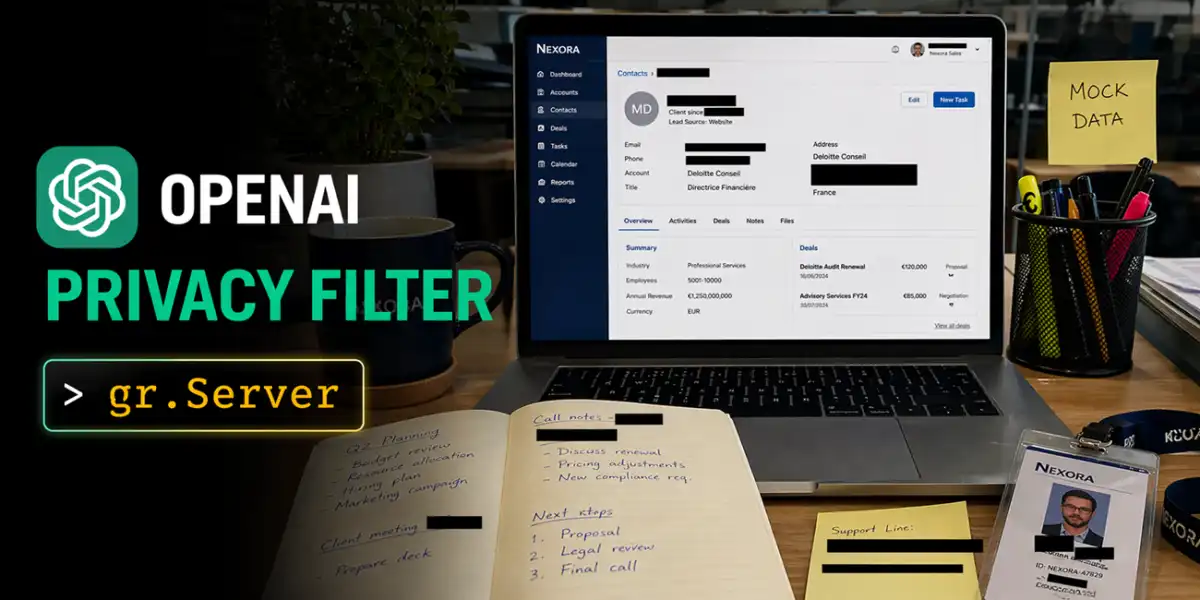
In a significant development for web app developers, OpenAI has released an open-source model called Privacy Filter, designed to detect and label sensitive information in text and document workflows. This breakthrough technology enables local execution of PII detection, making it easier to build privacy-aware apps without shipping user data to third-party redaction services.
**Background and Context**
The need for robust data governance has become increasingly pressing as AI-driven applications continue to grow in popularity. Traditional security measures often treat the LLM API call as a black box, assuming the provider handles all data sanitization. However, this assumption is no longer tenable. The release of OpenAI's Privacy Filter addresses this concern by providing an open-source solution for detecting and labeling sensitive information.
**Why it Matters to the Industry**
The significance of OpenAI's Privacy Filter lies in its ability to run locally on a user's device, eliminating the need for API calls or data transmission. This approach ensures that sensitive information remains within the control of the developer, reducing the risk of data leakage. Moreover, the model is designed to identify and label multiple categories of sensitive data, including names, addresses, emails, phone numbers, URLs, dates, account numbers, and secrets.
The practical benefit of using OpenAI's Privacy Filter is that developers can build a privacy layer in front of downstream models and systems. This makes it easier to protect user data before it reaches a chatbot, summarizer, classifier, or internal search pipeline. For the adult industry, this technology has far-reaching implications for data protection and compliance.
**What Comes Next**
To get started with OpenAI's Privacy Filter, developers can set up a local environment by pulling the model, installing the transformer stack, and testing basic text redaction first. It is essential to separate backend logic from the UI, using a server-based approach that makes concurrent uploads serialized and ensures correct @spaces.GPU composition on ZeroGPU.
**Key Facts**
- OpenAI's Privacy Filter is an open-source model for detecting and labeling sensitive information in text and document workflows.
- The model runs locally on a user's device, eliminating the need for API calls or data transmission.
- It identifies and labels multiple categories of sensitive data, including names, addresses, emails, phone numbers, URLs, dates, account numbers, and secrets.
- Developers can build a privacy layer in front of downstream models and systems to protect user data.
- The model is designed to work with large language models (LLMs) and can be integrated into web apps using OpenAI's API.
**Implementation and Integration**
To implement OpenAI's Privacy Filter, developers can use the provided code examples or integrate it into their existing applications. The model can be used in conjunction with other data protection measures, such as differential privacy and rate limiting, to ensure robust data governance.
In conclusion, OpenAI's Privacy Filter is a significant development for web app developers, providing an open-source solution for detecting and labeling sensitive information. Its ability to run locally on a user's device eliminates the need for API calls or data transmission, reducing the risk of data leakage. As the adult industry continues to rely on AI-driven applications, this technology has far-reaching implications for data protection and compliance.