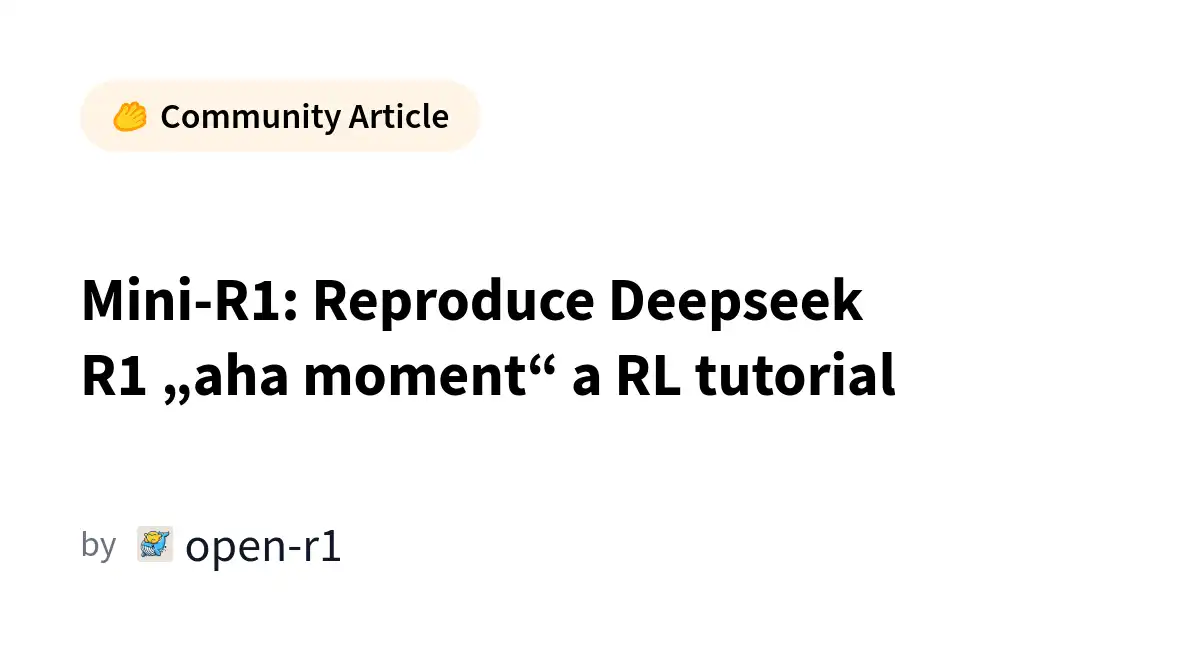
The release of DeepSeek R1 has sent shockwaves through the industry, with its open model rivaling OpenAI's o1 in complex reasoning tasks. The model was introduced using Group Relative Policy Optimization (GRPO) and a reinforcement learning-focused multi-stage training approach. In a recent blog post, Philipp Schmid replicated the "aha moment" of DeepSeek R1 using GRPO and the Countdown Game.
**Background and Context**
DeepSeek R1 is an open-source model that has been making waves in the industry due to its impressive performance in complex reasoning tasks. The model was trained using GRPO, a reinforcement learning algorithm designed to improve the reasoning capabilities of large language models (LLMs). GRPO modifies the traditional Proximal Policy Optimization (PPO) by eliminating the need for a value function model. Instead, it estimates baselines from the policy's performance on a set of tasks.
The Countdown Game is a numbers puzzle where players use a set of randomly drawn numbers and basic arithmetic operations to reach or get as close as possible to a target number. The game requires a combination of reasoning, problem-solving, and mathematical skills, making it an ideal testbed for evaluating the reasoning capabilities of LLMs.
**Reproducing the Aha Moment**
Philipp Schmid's blog post provides a step-by-step guide on how to replicate the "aha moment" of DeepSeek R1 using GRPO and the Countdown Game. The process involves generating training samples with reasoning prefixes from the Countdown Game, training the model using GRPO, and evaluating its performance on a set of tasks.
The blog post also includes an interactive code that can be run in a Jupyter Notebook to train a model using GRPO and Q-Lora. However, this approach requires significant computational resources and may not be feasible for all users.
**Distributed Training Using Deepspeed and vLLM**
To overcome the computational limitations of training models using GRPO, Schmid provides instructions on how to run the training process on a Node with multiple GPUs or a SLURM cluster. This allows users to distribute the training process across multiple machines, reducing the computational requirements and making it more accessible to a wider range of users.
**Why It Matters**
The replication of DeepSeek R1's "aha moment" using GRPO and the Countdown Game has significant implications for the industry. It demonstrates that the reasoning capabilities of LLMs can be improved using reinforcement learning algorithms, which can lead to more accurate and reliable decision-making in a variety of applications.
Furthermore, the use of distributed training methods makes it possible to train models on large datasets without requiring significant computational resources. This opens up new possibilities for researchers and developers who want to explore the potential of GRPO and other reinforcement learning algorithms.
**What Comes Next**
The replication of DeepSeek R1's "aha moment" using GRPO and the Countdown Game is an exciting development that has the potential to revolutionize the field of natural language processing. As researchers and developers continue to explore the possibilities of GRPO and other reinforcement learning algorithms, we can expect to see significant advancements in the performance and accuracy of LLMs.
**Key Facts**
- DeepSeek R1 is an open-source model that rivals OpenAI's o1 in complex reasoning tasks.
- The model was trained using Group Relative Policy Optimization (GRPO) and a reinforcement learning-focused multi-stage training approach.
- GRPO modifies the traditional Proximal Policy Optimization (PPO) by eliminating the need for a value function model.
- The Countdown Game is a numbers puzzle that requires a combination of reasoning, problem-solving, and mathematical skills.
- Philipp Schmid's blog post provides a step-by-step guide on how to replicate the "aha moment" of DeepSeek R1 using GRPO and the Countdown Game.
**Conclusion**
The replication of DeepSeek R1's "aha moment" using GRPO and the Countdown Game is an exciting development that has significant implications for the industry. As researchers and developers continue to explore the possibilities of GRPO and other reinforcement learning algorithms, we can expect to see significant advancements in the performance and accuracy of LLMs.