The adult industry's reliance on large-scale semantic search systems has long been hindered by the limitations of fixed-size embeddings. These rigid representations can consume significant storage and slow down similarity searches, forcing operators to choose between accuracy and efficiency. However, a recent breakthrough in natural language processing (NLP) research offers a solution: Matryoshka Representation Learning (MRL). This innovative approach enables a single embedding model to produce useful representations at various sizes, from the full dimension count down to a small fraction of it.
**What is Matryoshka Representation Learning?**
Matryoshka Representation Learning is a training method that allows a single embedding model to adapt to multiple downstream tasks with varying computational resources. The approach encodes information at different granularities, enabling a single embedding to be useful across various sizes. This flexibility is achieved by training the model to concentrate important information in the earliest dimensions, with later dimensions adding refinement and nuance.
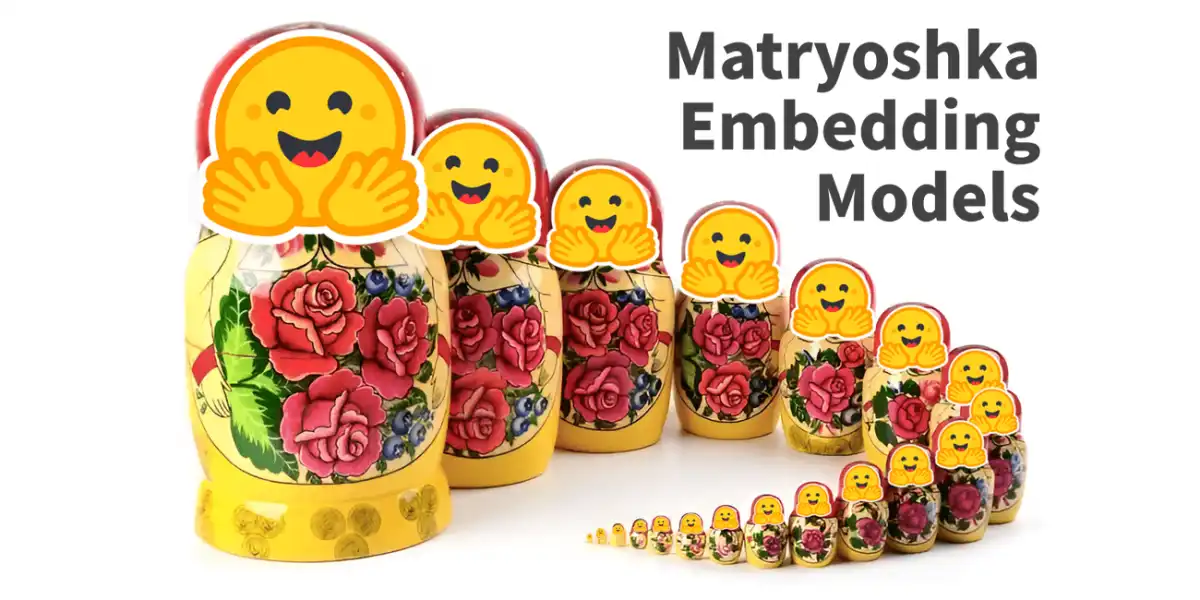
The name "Matryoshka" comes from Russian nesting dolls, where each doll contains a smaller, complete doll inside it. Similarly, MRL embeddings are like nested dolls, where the first 64 dimensions of a 1024-dimensional MRL embedding are themselves a meaningful 64-dimensional embedding. This analogy maps directly to the concept of MRL, where the model is trained to produce useful representations at various sizes.
**Background and Context**
The idea of Matryoshka Representation Learning was introduced in a 2022 paper by Aditya Kusupati and his team. The research demonstrated that MRL can adapt to multiple downstream tasks with varying computational resources, achieving up to 14x smaller embedding size for ImageNet-1K classification at the same level of accuracy. Additionally, MRL offers up to 14x real-world speed-ups for large-scale retrieval on ImageNet-1K and 4K.
The concept of Matryoshka Representation Learning has been gaining attention in the NLP community, with researchers exploring its applications in various domains. The approach has been implemented in popular libraries such as Sentence Transformers, making it accessible to developers and operators.
**Why It Matters to the Industry**
Matryoshka Representation Learning is particularly relevant to the adult industry's reliance on large-scale semantic search systems. By enabling a single embedding model to produce useful representations at various sizes, MRL can help operators overcome the limitations of fixed-size embeddings. This flexibility can lead to significant improvements in efficiency and accuracy, making it an attractive solution for industries with high storage and processing demands.
Moreover, Matryoshka Representation Learning can be used in conjunction with other techniques, such as shortlisting and reranking, to further optimize performance. By leveraging the strengths of MRL and other approaches, operators can create more efficient and accurate semantic search systems that meet the needs of their applications.
**What Comes Next**
As research on Matryoshka Representation Learning continues to evolve, we can expect to see more applications and implementations in various domains. The approach has already been integrated into popular libraries, making it accessible to developers and operators. However, further research is needed to fully explore the potential of MRL and its applications.
In conclusion, Matryoshka Representation Learning offers a promising solution for industries reliant on large-scale semantic search systems. By enabling a single embedding model to produce useful representations at various sizes, MRL can help operators overcome the limitations of fixed-size embeddings and create more efficient and accurate systems.
**Key Facts**
- Matryoshka Representation Learning is a training method that enables a single embedding model to adapt to multiple downstream tasks with varying computational resources.
- The approach encodes information at different granularities, allowing a single embedding to be useful across various sizes.
- MRL can achieve up to 14x smaller embedding size for ImageNet-1K classification at the same level of accuracy.
- The approach offers up to 14x real-world speed-ups for large-scale retrieval on ImageNet-1K and 4K.
- Matryoshka Representation Learning has been implemented in popular libraries such as Sentence Transformers, making it accessible to developers and operators.