Preview · this article is in the editorial review queue and is not yet approved for publish.
Review & approve →
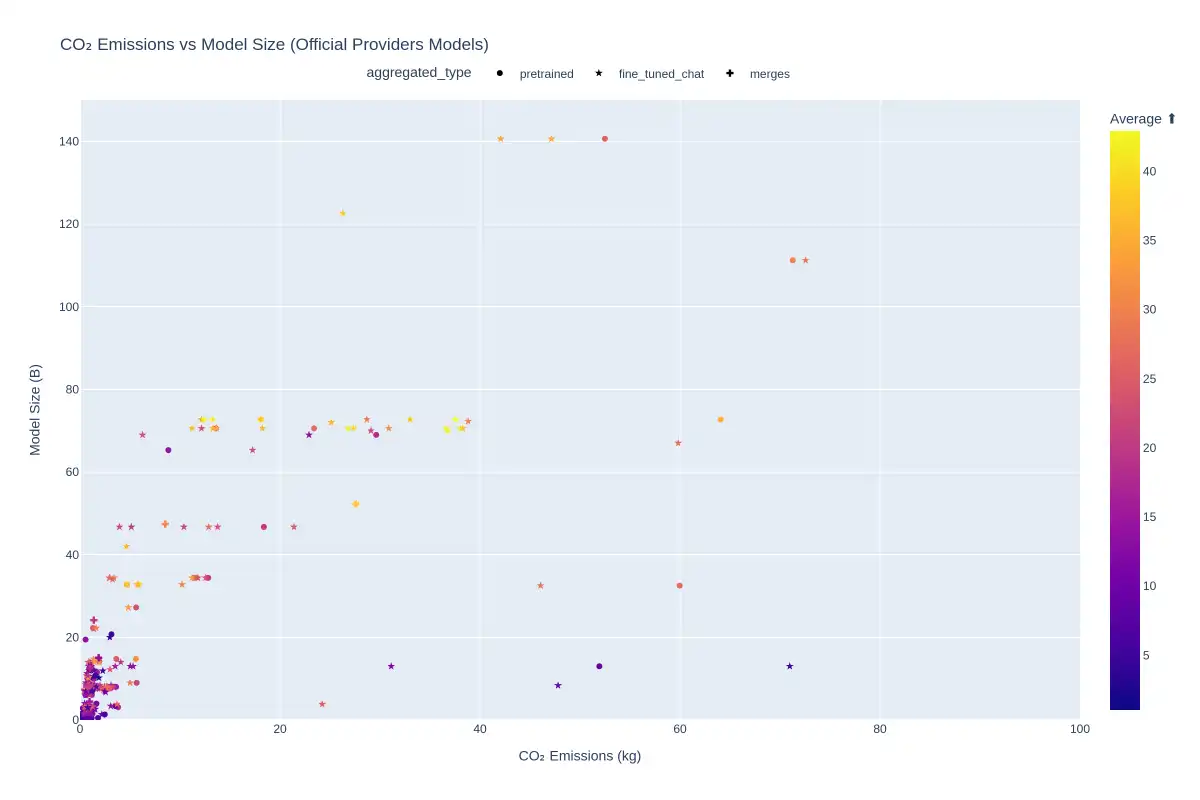
A recent study on the Open LLM Leaderboard reveals larger language models generate higher CO2 emissions, but smaller models demonstrate strong performance with lower carbon emissions.
Open LLM Leaderboard Study Reveals Complex Trade-offs Between Model Size and Emissions
A recent study published on the Open LLM Leaderboard has shed light on the environmental impact of large language models (LLMs) on climate change. The research, which analyzed over 2,700 models, found that larger models generate higher CO2 emissions, but their performance improvements don't always justify the increased environmental cost.
The study highlights the complex trade-offs between model size and emissions, with smaller models demonstrating strong performance while maintaining relatively low carbon emissions. In fact, models with fewer than 10 billion parameters show significant variations in efficiency between different implementation approaches. Community-developed fine-tuned models typically demonstrate better CO2 efficiency compared to official releases from
major AI companies.
Background and Context
The Open LLM Leaderboard is a worldwide ranking of open language models performance, with over 3,000 models evaluated since June 2024. The study's findings are significant because they reveal the environmental impact of large language models on climate change. Recent research has highlighted the challenges of managing resources efficiently at inference due to dynamic and diverse workloads.
By integrating carbon emission estimates into the Open LLM Leaderboard, researchers aim to provide transparency to users about the carbon impact of various model evaluations and encourage model creators to balance performance with environmental responsibility.
Key Findings
* Larger language models generate higher CO2 emissions, but their performance improvements don't always justify the increased environmental cost.
* Models with fewer than 10 billion parameters demonstrate strong performance while maintaining relatively low carbon emissions.
* Community-developed fine-tuned models typically demonstrate better CO2 efficiency compared to official releases from major AI companies.
Technical Performance Analysis
The study analyzed specific model families, including Qwen2 and Llama, which revealed significant variations in efficiency between different implementation approaches. Fine-tuning appeared to improve output coherence and conciseness across tested models. However, the exact mechanisms by which fine-tuning improves efficiency remain unclear.
Research Implications
The study raises important questions about the relationship between model architecture, training methods, and environmental impact. Further research is needed to understand the factors that influence model emissions. The findings suggest potential paths forward for developing more environmentally sustainable AI systems.
Environmental Considerations
As the AI field grapples with sustainability concerns, this research highlights the potential for optimizing language models for both performance and environmental impact. The study demonstrates that bigger isn't always better when considering the full cost-benefit analysis of model deployment.
Conclusion
The Open LLM Leaderboard study offers a glimpse into the true CO2 emissions of AI models, revealing complex trade-offs between model size and emissions. By integrating carbon emission estimates into the leaderboard and encouraging model creators to balance performance with environmental responsibility, researchers can reduce the environmental impact of large language models on climate change.
Key Facts
- Larger language models generate higher CO2 emissions, but their performance improvements don't always justify the increased environmental cost.
- Models with fewer than 10 billion parameters demonstrate strong performance while maintaining relatively low carbon emissions.
- Community-developed fine-tuned models typically demonstrate better CO2 efficiency compared to official releases from major AI companies.
- Fine-tuning appeared to improve output coherence and conciseness across tested models.
- The exact mechanisms by which fine-tuning improves efficiency remain unclear.