The Technology Innovation Institute (TII) in Abu Dhabi has unveiled Falcon 3, a family of open-source large language models that push the boundaries of performance and training efficiency. The new models are designed to democratize access to advanced artificial intelligence by enabling efficient operation on light infrastructures, including laptops. With superior reasoning and enhanced fine-tuning capabilities, Falcon 3 is poised to set new standards in AI capabilities.
What Happened
Falcon 3 represents a natural evolution from previous releases, emphasizing expanding the models' science, math, and code capabilities. The family includes five base models: Falcon3-1B-Base, Falcon3-3B-Base, Falcon3-Mamba-7B-Base, Falcon3-7B-Base, and Falcon3-10B-Base. These models are developed using several key innovations aimed at improving performance while reducing training costs.
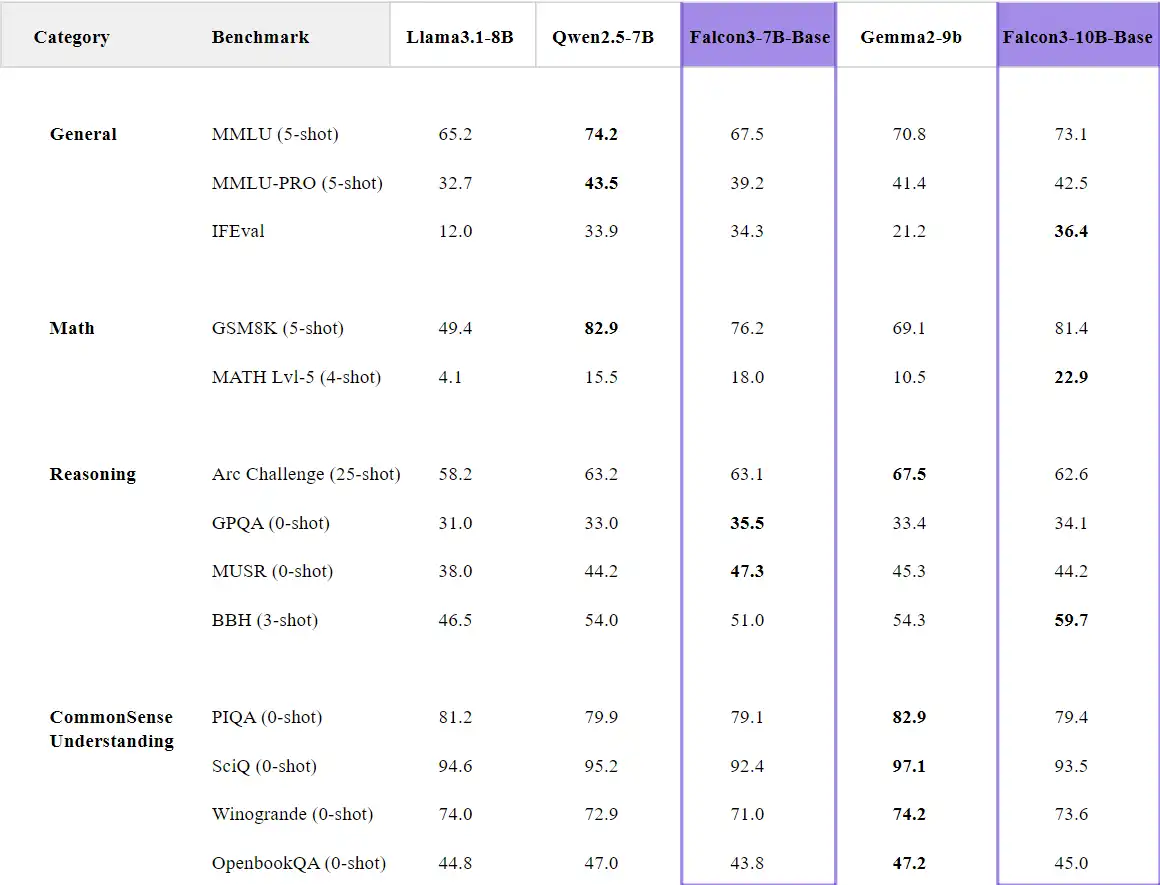
One of the notable advancements in Falcon 3 is the use of a single large-scale pre-training run on the 7B model, leveraging 14 trillion tokens featuring web, code, STEM, and curated high-quality and multilingual data. This approach has yielded significant improvements in performance, with Falcon3-10B-Base achieving state-of-the-art zero-shot and few-shot performance for models under 13 billion parameters.
Background and Context
The Technology Innovation Institute (TII) is a leading global applied research center under Abu Dhabi's Advanced Technology Research Council (ATRC). The institute has been actively contributing to the development of open-source large language models, with previous releases such as Falcon 1 and Falcon 2. Falcon 3 builds upon this foundation, pushing the boundaries of performance and training efficiency.
The use of a single pre-training run on the 7B model is a significant innovation in Falcon 3. This approach allows for more efficient training and reduces the computational resources required, making it possible to operate on light infrastructures such as laptops. The models are also designed to be fully compatible with widely used APIs (Application Programming Interfaces) and libraries, reducing integration efforts and ensuring ease of use.
Why It Matters to the Industry
The release of Falcon 3 has significant implications for the adult industry, particularly in terms of AI-powered content creation and moderation. The models' superior reasoning and fine-tuning capabilities make them well-suited for tasks such as natural language processing, code generation, and mathematical tasks. This can enable more efficient and effective content creation, as well as improved moderation capabilities.
The use of open-source large language models like Falcon 3 also democratizes access to advanced AI capabilities, allowing developers and operators in the adult industry to leverage these technologies without relying on proprietary solutions. This can lead to increased innovation and competitiveness in the market.
What Comes Next
In January 2025, TII plans to release additional models of the Falcon 3 family featuring enhanced multi-modal capabilities, including image, video, and audio support. The institute also welcomes feedback and collaboration from the community as they continue to refine and advance these technologies.
Key Facts
- Falcon 3 is a family of open-source large language models developed by Technology Innovation Institute (TII) in Abu Dhabi.
- The models are designed to democratize access to advanced artificial intelligence by enabling efficient operation on light infrastructures, including laptops.
- Falcon 3 includes five base models: Falcon3-1B-Base, Falcon3-3B-Base, Falcon3-Mamba-7B-Base, Falcon3-7B-Base, and Falcon3-10B-Base.
- The models are developed using several key innovations aimed at improving performance while reducing training costs.
- Falcon 3 is designed to be fully compatible with widely used APIs (Application Programming Interfaces) and libraries, reducing integration efforts and ensuring ease of use.