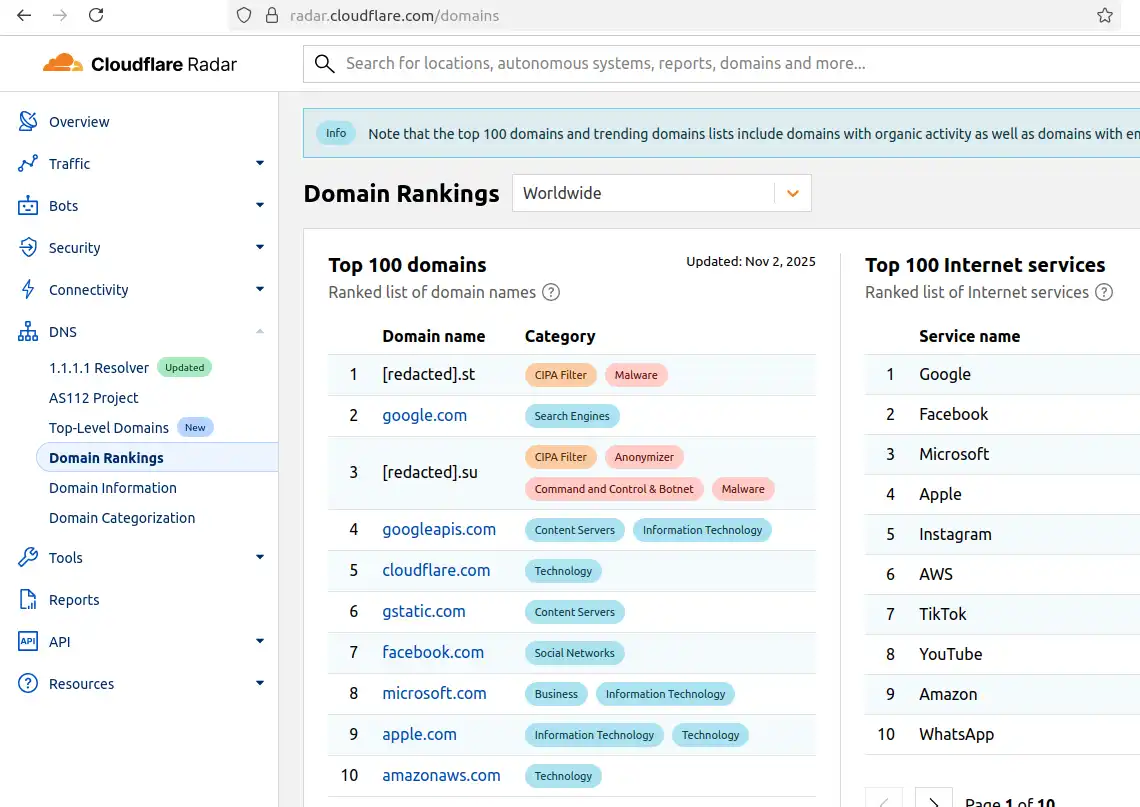
The Cloudflare domain ranking system has been compromised by the massive Aisuru botnet, which has repeatedly usurped Amazon, Apple, Google, and Microsoft in the company's public ranking of the most frequently requested websites. For the past week, domains associated with the botnet have populated the top positions on Cloudflare's list, sparking concerns about security, brand confusion, and privacy. In response, Cloudflare has partially redacted the malicious domains and added a warning at the top of its rankings.
Background and Context
Aisuru is a rapidly growing botnet comprising hundreds of thousands of hacked Internet of Things (IoT) devices, such as poorly secured Internet routers and security cameras. The botnet has increased in size and firepower significantly since its debut in 2024, demonstrating the ability to launch record distributed denial-of-service (DDoS) attacks nearing 30 terabits of data per second.
Until recently, Aisuru's malicious code instructed all infected systems to use DNS servers from Google — specifically, the servers at 8.8.8.8. But in early October, Aisuru switched to invoking Cloudflare's main DNS server — 1.1.1.1 — and over the past week domains used by Aisuru to control infected systems started populating Cloudflare's top domain rankings.
As screenshots of Aisuru domains claiming two of the Top 10 positions ping-ponged across social media, many feared this was yet another sign that an already untamable botnet was running completely amok. One Aisuru botnet domain that sat prominently for days at #1 on the list was someone's street address in Massachusetts followed by ".com". Other Aisuru domains mimicked those belonging to major cloud providers.
Why it Matters to the Industry
The compromise of Cloudflare's domain ranking system highlights the vulnerability of large-scale DNS services to botnet attacks. The fact that Aisuru was able to manipulate the rankings and populate the top positions with malicious domains raises concerns about the accuracy and reliability of such systems.
For adult-industry platforms and operators, this development is particularly relevant due to the potential for malicious domains to be used for phishing, malware distribution, or other types of cybercrime. The compromised ranking system could also lead to brand confusion and damage to reputation if legitimate websites are mistakenly associated with malicious activity.
The fact that Aisuru's overlords are using the botnet to boost their malicious domain rankings while simultaneously attacking Cloudflare's DNS service further underscores the complexity and sophistication of modern botnets. This development highlights the need for robust security measures, including advanced threat detection and mitigation techniques, to protect against such attacks.
What Comes Next
Cloudflare has acknowledged the issue and taken steps to address it by partially redacting the malicious domains and adding a warning at the top of its rankings. However, experts warn that this may not be enough to prevent similar incidents in the future.
Renee Burton, vice president of threat intelligence at Infoblox, noted that Cloudflare's documentation is clear about the limitations of their domain ranking system. "There are many aspects that are simply out of your control," she wrote on LinkedIn. "Why is it hard? Because reasons. TTL values, caching, prefetching, architecture, load balancing."
Cloudflare CEO Matthew Prince acknowledged the simplicity of their domain ranking system and stated that they are working to make it smarter. However, experts warn that this may not be enough to prevent similar incidents in the future.
Key Facts
- Aisuru is a rapidly growing botnet comprising hundreds of thousands of hacked IoT devices.
- The botnet has increased in size and firepower significantly since its debut in 2024, demonstrating the ability to launch record DDoS attacks nearing 30 terabits of data per second.
- Aisuru's malicious code instructed all infected systems to use DNS servers from Google until early October, when it switched to invoking Cloudflare's main DNS server — 1.1.1.1.
- Domains used by Aisuru to control infected systems started populating Cloudflare's top domain rankings over the past week.
- Cloudflare has partially redacted the malicious domains and added a warning at the top of its rankings.
- The compromised ranking system highlights the vulnerability of large-scale DNS services to botnet attacks.
In conclusion, the compromise of Cloudflare's domain ranking system by the Aisuru botnet highlights the need for robust security measures and advanced threat detection techniques to protect against such attacks. The fact that malicious domains can manipulate rankings and populate top positions raises concerns about accuracy and reliability, and underscores the complexity and sophistication of modern botnets.