Your news site, on autopilot.
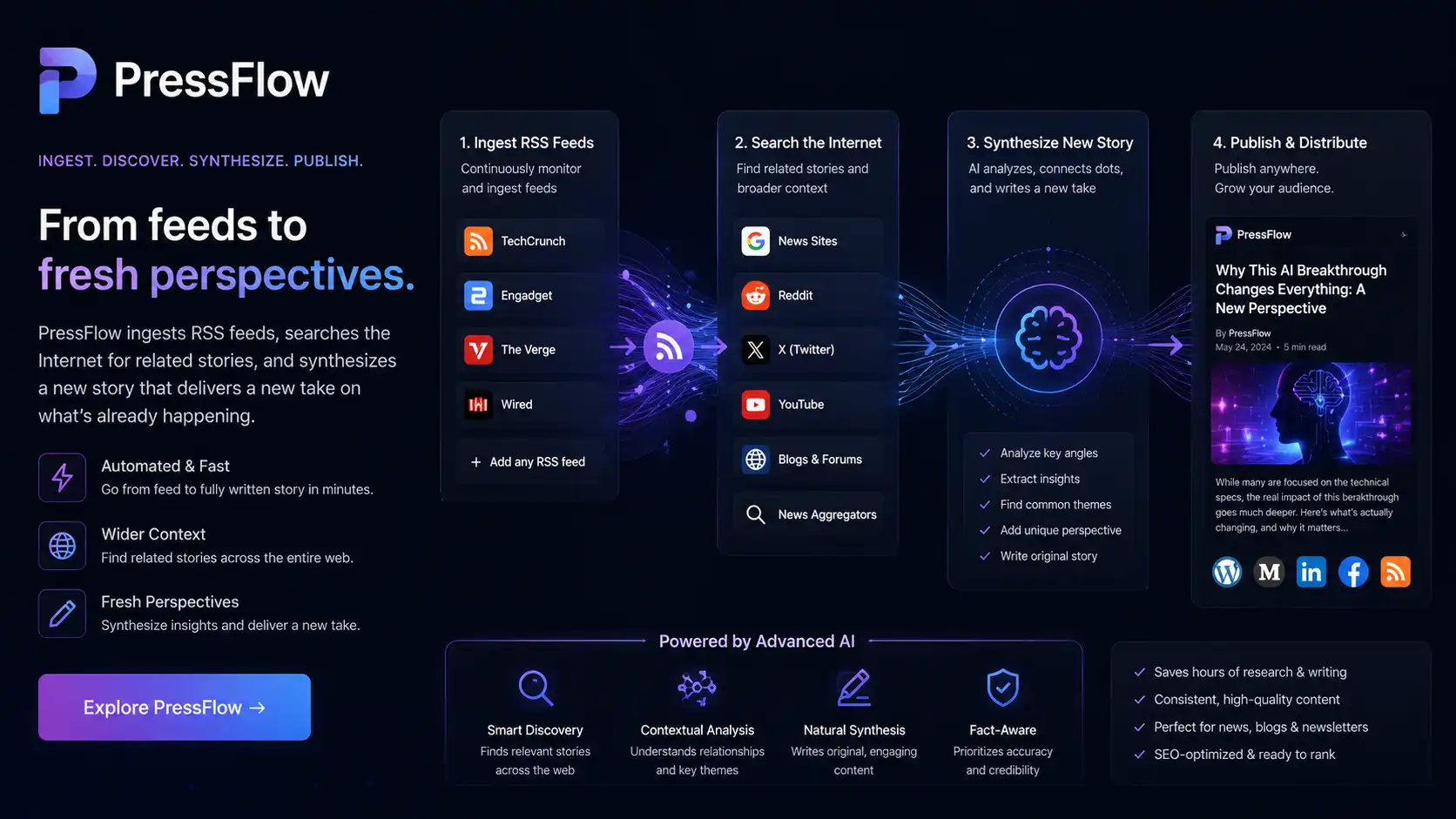
Point PressFlow at any RSS feed in your topic area. It researches every story, drafts a full-length article from multiple sources, picks a featured image, and publishes — on your schedule, under your brand, with or without editorial review.
An RSS feed isn't a news site. A news site needs articles.
News-driven sites win on freshness. But hiring writers to turn every headline into a 500-word piece is expensive, slow, and fragile. Aggregator widgets produce thin pages that search engines and readers ignore.
The two bad options most operators settle for
- Hire writers per article$50–$200 per piece. Slow turnaround. Hard to scale. Output quality varies.
- Run an aggregator widgetOne-sentence excerpts that don't rank. Looks like a feed reader, not a news site.
- Either way, the site looks thinTo repeat visitors and to search engines.
What PressFlow does instead
- Pulls headlines from feeds you chooseTrade publications, wire services, competitors, industry sources.
- Researches each story across multiple sourcesNot a single-source paraphrase — multi-source synthesis.
- Writes a full original article per story300–800 words with title, meta, FAQ, and JSON-LD schema.
- Publishes when you say soReview queue or fully automatic — your call.
Set the topic. Let PressFlow handle the desk work.
-
1
Add your feeds
Paste any RSS URLs into the admin — trade publications, wire services, industry sources. Enable, disable, or rename feeds at any time.
-
2
PressFlow researches
For each new headline, it pulls outside coverage from across the open web so the resulting article isn't a regurgitation of a single source.
-
3
AI drafts the article
A polished 300–800 word piece is written with title, meta description, FAQ block, and JSON-LD schema. Featured image picked automatically from source material.
-
4
You publish — or it does
Review in the queue and approve, or switch to auto-approve and let it run hands-off. Hide, edit, or delete anything at any time.
Not just automation — a full editorial system.
PressFlow isn't only for automated RSS-driven articles. Three article creation paths are built in and all land in the same review queue.
From RSS: the hourly auto-pull runs on every feed you've configured. New headlines become full articles without any action on your part.
From pitch: give the AI a headline and let it research and draft. Useful for breaking news or topics you want to cover that aren't in your feeds yet.
From scratch: write your own post in the admin editor. All three paths produce the same structured output with schema and SEO metadata.
A full news platform, out of the box.
Not just a draft generator. PressFlow is your CMS, your feed reader, and your editor in one.
Multi-Feed Ingest
Pull from as many RSS sources as you want — trade publications, wire services, competitor sites, industry blogs. Enable, disable, or rename feeds from the admin at any time. The pipeline iterates oldest-pulled-first so every feed gets fair attention from the hourly cron.
AI Article Synthesis
Full 300–800 word articles drawn from multiple outside sources per story — not paraphrased from the headline alone. Title, meta description, article body, FAQ block, and JSON-LD Article and FAQPage schema are all generated together. Articles pass typical originality checks comfortably.
Editorial Review Queue
Side-by-side view of the original RSS item and the AI-enriched article. Approve, reject, or edit before anything goes live. Or skip review entirely with auto-approve mode. Hide, edit, and delete are available at any time regardless of mode.
Automatic Featured Images
PressFlow harvests images from source pages, resizes to a standard hero size, converts to WebP, and selects the best one as the article's featured image. A branded placeholder is generated automatically when nothing usable is found in the sources.
Topic-Cluster Hub Pages
People, organisations, and places mentioned across your articles automatically get topic hub pages and dedicated RSS feeds — the SEO topic-cluster pattern, built in, requiring no manual tagging or category assignment from editors.
Pin, Hide & Site-Wide RSS
Pin any story to the top of your site in any order you choose. Hide articles from the public site without deleting them. PressFlow publishes its own site-wide RSS feed and a dedicated feed per topic hub, so readers and partners can subscribe through standard RSS 2.0.
Now it builds an audience — and a revenue stream.
PressFlow isn't just publishing. The platform includes reader accounts, moderated comments, a press release intake that earns inbound links, and a built-in ad manager with a ready-made media kit.
Reader Accounts
Free reader sign-up with email confirmation and password reset. Account emails are CAN-SPAM compliant and sent under your brand — no PressFlow or LCNTech branding in your readers' inboxes.
Moderated Comments
Signed-in readers leave real comments, held for your approval before they appear. Built-in anti-spam covers honeypots, rate-limits, and link caps. One-click block-and-purge for bad actors.
AI Discussion Seeding
An optional layer seeds new articles with synthetic persona comments and reaction votes so a brand-new post never looks empty. Real reader comments appear alongside them. Toggle on or off per site.
Press Release Intake
A public submission form lets brands send you press releases with a headline, body, and image (auto-converted to WebP). Each lands in your review queue and, once approved, reads like any other article on your site.
Built-in Backlink Engine
Submitters earn sticky homepage placement by linking back to their published release from their own site. One click in the admin verifies the backlink and auto-pins the story — turning every accepted submission into an inbound link to your domain.
Ad Manager & Media Kit
Banner zones across the homepage, article pages, and a sticky sidebar, plus an embeddable headlines widget that carries your ads onto partner sites. Accepts static image creatives or third-party ad network tags. Weighting, scheduling, and impression/click tracking included. A public advertising rate-card page comes ready to sell from.
Hosted by us, or installed on your server.
Same software either way. Pick the deployment that matches how hands-on you want to be with infrastructure.
- Hosted on LCNTech infrastructure
- AI usage included — no separate API bills
- Your own domain or a branded subdomain
- Daily backups, SSL, software updates
- Email support and setup assistance
- White-label, cancel anytime
- Install on your own cPanel, VPS, or dedicated server
- Bring your own AI API keys (OpenAI, Gemini, or local Ollama)
- Your data stays on your hardware
- Setup assistance and 12 months of updates
- Optional $299/year support renewal after year one
- White-label, no per-deployment fees
Both plans include a 7-day money-back guarantee. Not sure which fits? Talk to us and we'll help you choose.
What publishers usually ask.
How is PressFlow different from an RSS aggregator?
An aggregator republishes the headline and a one-sentence excerpt. PressFlow produces a fact-grounded 300–800 word article per story, with its own SEO meta description, JSON-LD schema, automatic featured image, and topic-cluster links. Real editorial content, not a headline widget.
Will the articles be unique?
Every article is freshly synthesised from multiple researched sources, with its own title, meta description, body, FAQ block, and schema. PressFlow does not republish content verbatim. Output passes typical originality checks comfortably. We always recommend the review queue for high-stakes pages.
What's the difference between Cloud and Self-Hosted?
Cloud ($149/mo): we run the servers, AI usage, updates, and backups. You log in, manage feeds, and approve articles. Self-hosted ($1,499 one-time): you install the software on your own server, bring your own AI API keys, and run it yourself. Self-hosted includes 12 months of updates and setup assistance.
How automated is "automated"?
Configurable per site. Manual mode: every article waits in the review queue for editorial approval. Auto-approve: articles publish immediately as they're drafted. Hide, edit, and delete remain available either way. Most operators start manual and move to auto-approve once they're comfortable with the output quality.
How does the press release backlink engine work?
Brands submit a press release through your public intake form. Once you approve and publish it, the submitter is invited to earn sticky homepage placement by linking back to the release from their own site. One click in your admin verifies that backlink and auto-pins the story — so every accepted submission becomes an inbound link to your domain.
Ready to run a news site without writing the news?
Tell us your topic area and how you want to publish. We will help you choose Cloud or self-hosted and get your first articles flowing the same day.