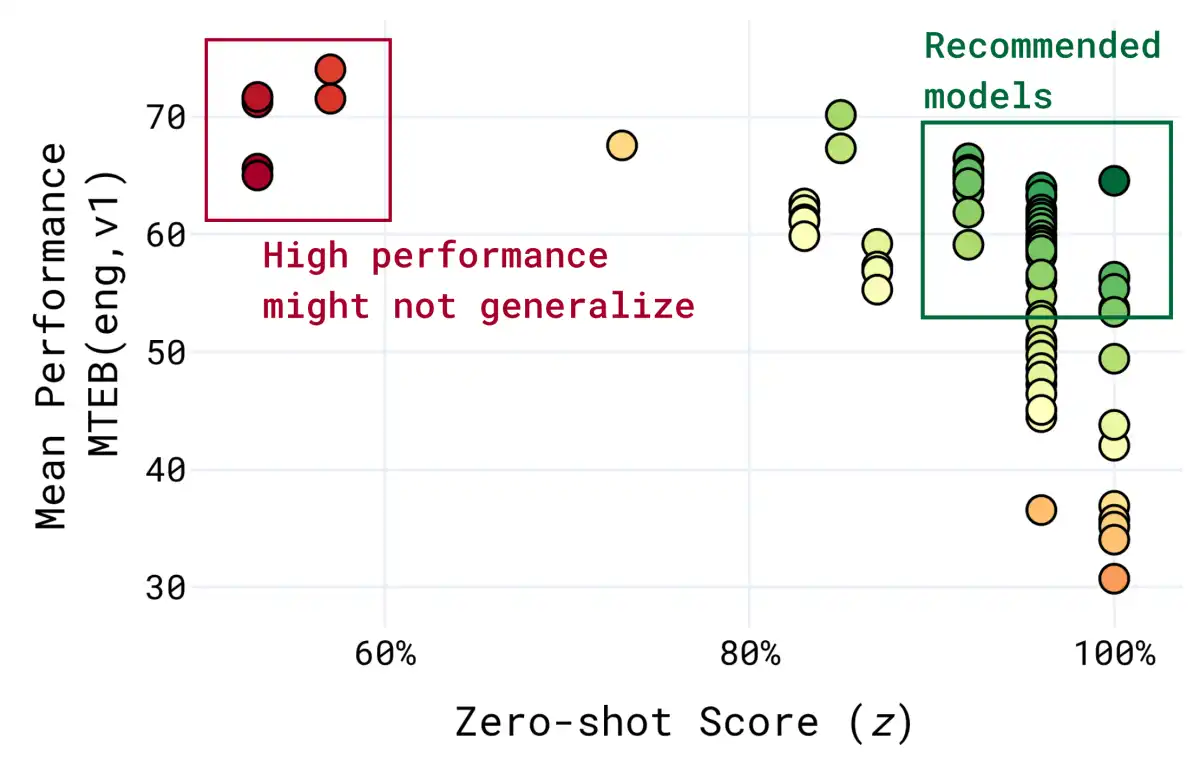
The adult industry's reliance on AI-powered search and retrieval systems has long been plagued by issues of accuracy and relevance. A new benchmark, called RTEB (Retrieval Embedding Benchmark), aims to address these problems by providing a more accurate measure of how well embedding models generalize in real-world retrieval tasks.
What is RTEB?
RTEB is a hybrid evaluation framework that combines open datasets, which are public and reproducible, with private datasets that remain accessible only to the MTEB maintainers. This approach ensures that results reflect genuine generalization rather than memorization. For each private dataset, only descriptive statistics and sample examples are released, maintaining transparency while preventing data leakage.
The launch of RTEB has already sparked discussion among AI researchers and practitioners. On LinkedIn, Shai Nisan, Ph.D., head of AI at Copyleaks, commented: "Beautiful!" However, the significance of RTEB extends far beyond a simple comment. By addressing the generalization gap in retrieval models, RTEB has the potential to revolutionize the way we approach search and retrieval in the adult industry.
Background and Context
The current state of retrieval evaluation is plagued by issues such as overfitting to public benchmarks and a lack of real-world applicability. Models may perform well on public benchmarks but often fall short in production due to being indirectly trained on that evaluation data, resulting in a "generalization gap." This makes it difficult for developers to predict how their models will handle unseen data.
Existing benchmarks such as BEIR (Benchmarking Information Retrieval) have attempted to address these issues by providing a heterogeneous benchmark of 18 datasets spanning diverse IR tasks and domains. However, BEIR's broad coverage quickly made it a standard for evaluating general-purpose retrievers, but its reliance on public datasets meant that models could eventually "see" them during training, raising concerns about overfitting.
Why It Matters to the Industry
The adult industry relies heavily on AI-powered search and retrieval systems to provide users with relevant and accurate results. However, the current state of retrieval evaluation means that these models are often not accurately reflecting their true performance in real-world scenarios. This can lead to issues such as irrelevant results and LLMs (Large Language Models) that hallucinate answers.
RTEB's hybrid evaluation framework addresses these issues by providing a more accurate measure of how well embedding models generalize in real-world retrieval tasks. By combining open datasets with private datasets, RTEB ensures that results reflect genuine generalization rather than memorization. This makes it an essential tool for developers and researchers working on search and retrieval systems in the adult industry.
What Comes Next
The launch of RTEB marks a significant step forward in the development of more accurate and relevant search and retrieval systems. However, there are still many challenges to be addressed before RTEB can become a widely adopted standard for retrieval evaluation.
One key challenge is the need for more diverse and representative datasets. While RTEB includes datasets across critical domains such as law, healthcare, finance, and code, there is still a need for more data in other areas. Additionally, the private datasets used by RTEB are currently only accessible to the MTEB maintainers, which may limit their availability.
Key Facts
- RTEB is a hybrid evaluation framework that combines open datasets with private datasets.
- The private datasets used by RTEB are currently only accessible to the MTEB maintainers.
- RTEB includes datasets across critical domains such as law, healthcare, finance, and code.
- RTEB covers 20 languages from English and Japanese to Bengali and Finnish.
- The benchmark's simplicity is deliberate: datasets are large enough to be meaningful but small enough to enable efficient evaluation.
In conclusion, the launch of RTEB marks a significant step forward in the development of more accurate and relevant search and retrieval systems. By addressing the generalization gap in retrieval models, RTEB has the potential to revolutionize the way we approach search and retrieval in the adult industry.