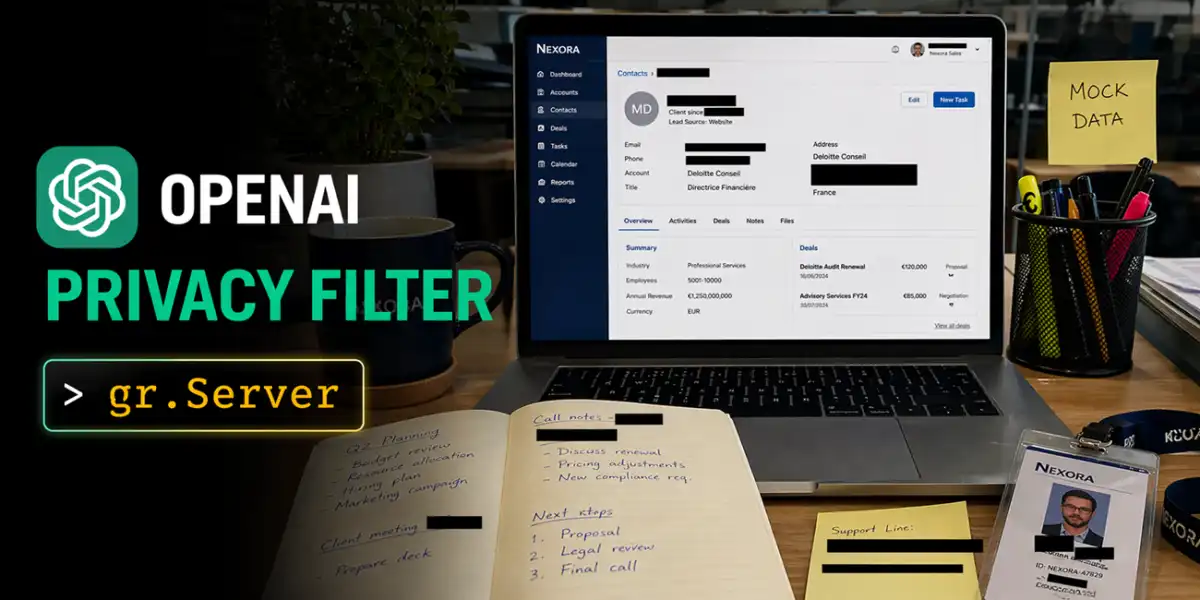
OpenAI has released Privacy Filter, an open-source model designed to detect and redact personally identifiable information (PII) in text. The model is available under the Apache 2.0 license on Hugging Face and GitHub, allowing developers to experiment, customize, and deploy it commercially.
What Happened
OpenAI Privacy Filter is a bidirectional token-classification model that can analyze language and context to identify sensitive information in unstructured text. The model distinguishes between public information and data linked to private individuals, reducing unnecessary redaction while still masking sensitive details.
The model uses a fine-tuned version of the gpt-oss architecture, but with a smaller size, making it suitable for high-throughput data sanitization workflows where teams need a fast, context-aware, and tunable model that can run on-premises. The model has 1.5 billion total parameters, but only about 50 million are active during use, which helps improve speed.
OpenAI claims it uses a fine-tuned version of Privacy Filter in its own privacy-preserving workflows, demonstrating the model's effectiveness in detecting and masking PII. The company also notes that the model can be adapted to specific domains through fine-tuning on smaller datasets, improving performance.
Background and Context
The release of OpenAI Privacy Filter is part of a broader effort by the company to support a more resilient software ecosystem by providing developers with practical infrastructure for building with AI safely. This includes tools and models that make privacy and security protections easier to implement from the start.
OpenAI's announcement highlights the importance of protecting sensitive information in text, particularly when interacting with AI tools like ChatGPT. The company notes that people tend to paste personal data into these tools, which can lead to exposure and risk.
The model is designed to analyze language and context to improve how it identifies sensitive information. It can detect a broader range of PII in unstructured text, including cases where classification depends on context. The model sorts sensitive data into eight categories, including names, addresses, emails, phone numbers, URLs, dates, account numbers, and secrets.
Why it Matters to the Industry
The release of OpenAI Privacy Filter has significant implications for adult-industry platforms and operators. With the increasing use of AI-powered tools in content creation and moderation, protecting sensitive information in text becomes a critical concern.
The model's ability to detect PII in unstructured text can help reduce unnecessary redaction while still masking sensitive details. This is particularly important for adult-industry platforms that handle large amounts of user-generated content, where sensitive information may be present.
Moreover, the model's fine-tunability and adaptability to specific domains make it an attractive solution for adult-industry operators who need to implement PII detection and masking in their workflows. The model's small size and ability to run locally also reduce the risk of exposure and improve speed.
What Comes Next
The release of OpenAI Privacy Filter marks a significant step towards improving PII detection and masking in text. As the adult industry continues to adopt AI-powered tools, protecting sensitive information becomes increasingly important.
OpenAI's announcement highlights the importance of collaboration between developers and operators to build more resilient software ecosystems that prioritize privacy and security. The release of Privacy Filter demonstrates OpenAI's commitment to providing practical infrastructure for building with AI safely.
Key Facts
- OpenAI has released Privacy Filter, an open-source model designed to detect and redact PII in text.
- The model is available under the Apache 2.0 license on Hugging Face and GitHub.
- Privacy Filter uses a fine-tuned version of the gpt-oss architecture with a smaller size, making it suitable for high-throughput data sanitization workflows.
- The model has 1.5 billion total parameters but only about 50 million are active during use, improving speed.
- OpenAI claims to use a fine-tuned version of Privacy Filter in its own privacy-preserving workflows.
- The model can be adapted to specific domains through fine-tuning on smaller datasets, improving performance.
As the adult industry continues to adopt AI-powered tools, protecting sensitive information becomes increasingly important. The release of OpenAI Privacy Filter marks a significant step towards improving PII detection and masking in text, demonstrating OpenAI's commitment to providing practical infrastructure for building with AI safely.