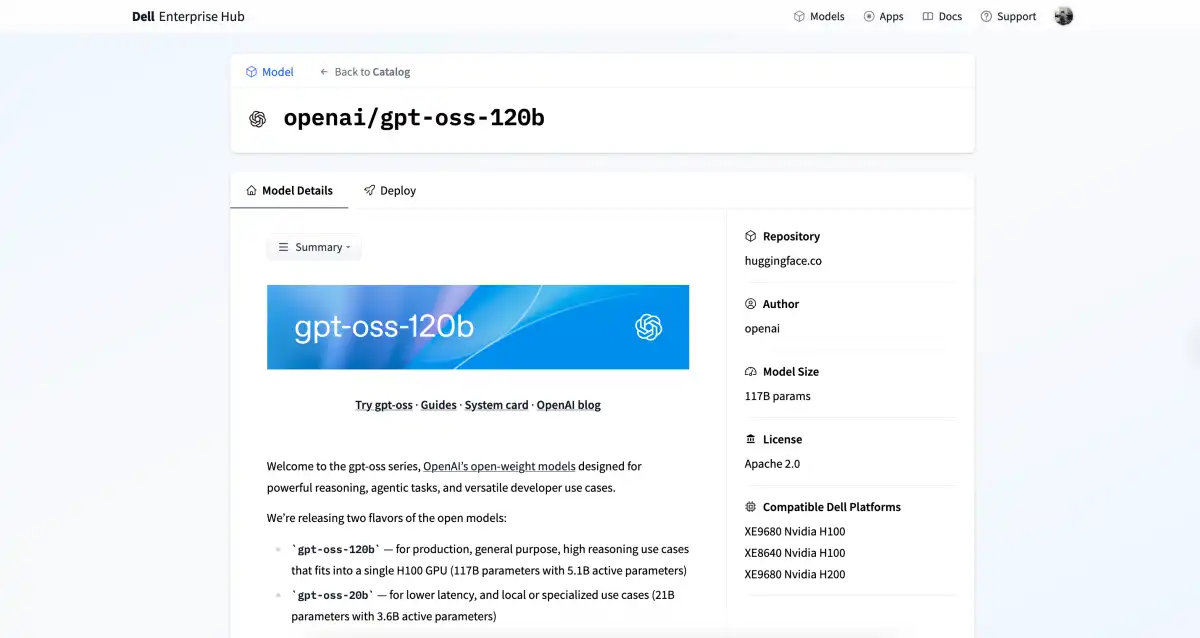
OpenAI has released two new open-source language models, gpt-oss-120b and gpt-oss-20b, designed for powerful reasoning, agentic tasks, and versatile developer use cases. The models are available under the Apache 2.0 license and have been optimized for efficient deployment on consumer hardware.
What Happened
The release of gpt-oss marks a significant step in OpenAI's commitment to making AI broadly accessible through open-source models. According to OpenAI, these models outperform similarly sized open models on reasoning tasks and demonstrate strong tool use capabilities. The large model, gpt-oss-120b, achieves near-parity with OpenAI's proprietary o4-mini model on core reasoning benchmarks while running efficiently on a single 80 GB GPU.
The smaller model, gpt-oss-20b, delivers similar results to OpenAI's proprietary o3-mini model on common benchmarks and can run on edge devices with just 16 GB of memory. Both models have been trained using a mix of reinforcement learning and techniques informed by OpenAI's most advanced internal models, including o3 and other frontier systems.
Background and Context
The development of gpt-oss is part of OpenAI's ongoing effort to make AI more accessible and transparent. By releasing open-source models, OpenAI aims to enable developers to build custom AI agents that can reason over enterprise data and domains. The company has been working on various projects, including o3 and o4, which have demonstrated strong performance in reasoning tasks.
OpenAI's decision to release gpt-oss under the Apache 2.0 license is significant, as it allows developers to use and modify the models freely. This move is expected to accelerate innovation in AI research and development, particularly in areas such as natural language processing and computer vision.
Why It Matters to the Industry
The release of gpt-oss has significant implications for the adult industry, which relies heavily on AI-powered chatbots and virtual assistants. The models' ability to perform powerful reasoning and agentic tasks makes them an attractive option for developers looking to build sophisticated AI agents.
One key advantage of gpt-oss is its efficiency in deployment. The models can run on consumer hardware with minimal resources, making them ideal for use cases such as search, chat, and real-time decisioning. This is particularly important for adult industry platforms, which often require fast and scalable AI solutions to handle high traffic and user engagement.
What Comes Next
The release of gpt-oss marks the beginning of a new era in open-source AI development. As more developers begin to explore and build upon these models, we can expect to see significant advancements in AI research and innovation.
Databricks has already partnered with OpenAI to launch gpt-oss on their platform, enabling users to build custom AI agents that can reason over enterprise data and domains. This partnership is expected to accelerate the adoption of gpt-oss in various industries, including the adult industry.
Key Facts
- Two new open-source language models: gpt-oss-120b and gpt-oss-20b, designed for powerful reasoning, agentic tasks, and versatile developer use cases.
- Apache 2.0 license: allows developers to use and modify the models freely.
- Efficient deployment: can run on consumer hardware with minimal resources.
- Reasoning capabilities: outperform similarly sized open models on reasoning tasks.
- Tool use capabilities: demonstrate strong tool use capabilities.
- Partnership with Databricks: enables users to build custom AI agents that can reason over enterprise data and domains.
The release of gpt-oss marks a significant step in OpenAI's commitment to making AI broadly accessible through open-source models. As more developers begin to explore and build upon these models, we can expect to see significant advancements in AI research and innovation.