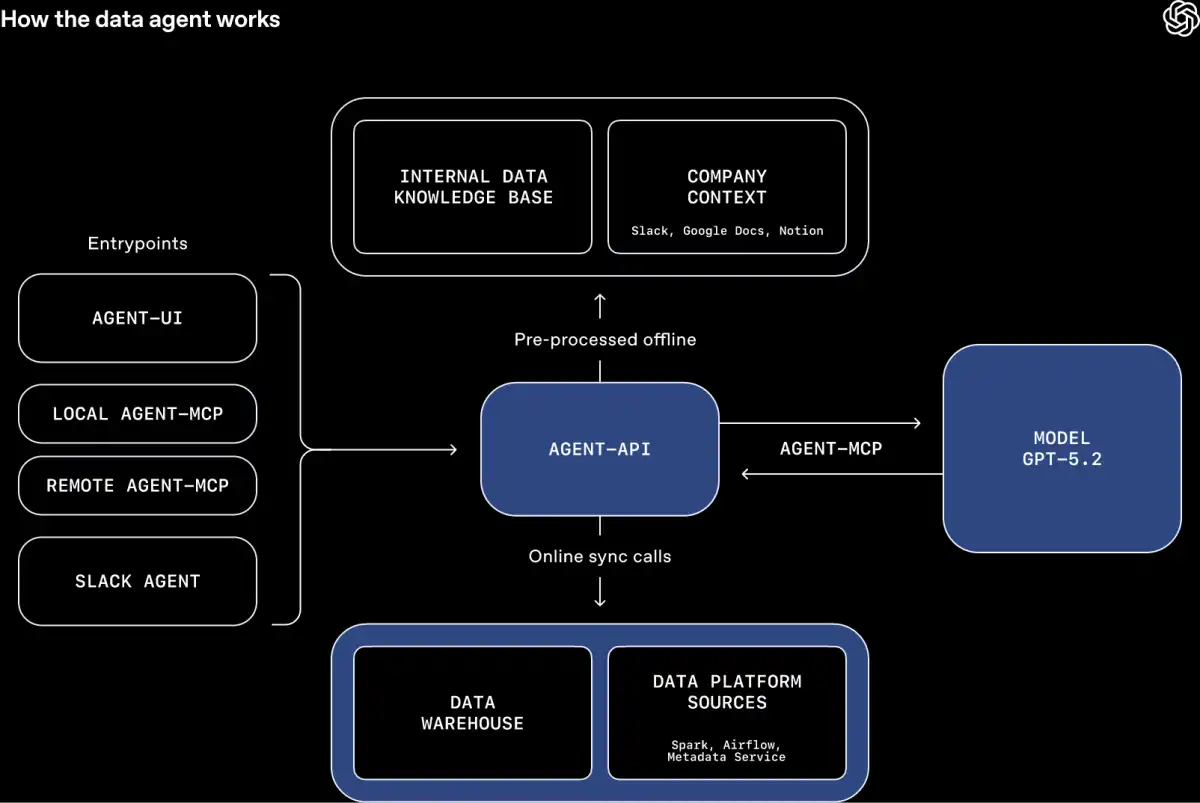
A leading AI research organization has developed an innovative data agent that enables employees to ask complex questions and receive actionable insights in minutes, rather than days or weeks. OpenAI's in-house data agent uses natural language processing (NLP) to reason over massive datasets, providing a unified semantic layer for business terms, tables, fields, and policies.
The data agent is built on top of OpenAI's GPT-5.2 model and has been integrated into various tools used by employees, including Slack, web interfaces, IDEs, and the Codex command-line interface. This allows team members to ask questions in plain English and receive structured output, such as charts, dashboards, or long-form analytical writeups.
Background and Context
OpenAI operates at an enormous scale, with a data platform spanning over 600 petabytes across roughly 70,000 datasets. This presents significant challenges for analysts, who often spend hours hunting for the right table, decoding business logic baked into SQL written months ago, and running query after query to validate their results.
The company's internal Data Platform team, led by head of data infrastructure Emma Tang, oversees big data systems, streaming, and the data tooling layer. According to Tang, out of about 5,000 OpenAI employees, more than 4,000 use the team's data tools. The agent fundamentally changes this starting point, allowing finance analysts to type a question in plain English into Slack and receive a finished chart within minutes.
OpenAI's internal estimates suggest that the tool saves two to four hours of work per query. However, Tang emphasizes that the more important impact is qualitative: the agent surfaces analyses that employees would not have attempted at all under the old workflow.
Why it Matters to the Industry
The development of OpenAI's data agent has significant implications for the adult industry, where large-scale datasets and complex analytics are increasingly common. The ability to reason over massive datasets using natural language processing can help platform operators and developers streamline their workflows, reduce latency, and improve scalability.
Moreover, the agent's unified semantic layer provides a standardized framework for business terms, tables, fields, and policies, which can help mitigate the risk of "wrong join" mistakes. This is particularly relevant in industries where data accuracy and integrity are paramount.
The use of an agent loop with guardrails also ensures that queries are properly validated and verified before returning results, reducing the risk of errors or security breaches. Additionally, the provenance and verification features provide transparency into the datasets used to generate insights, which can help build trust among users.
Key Features and Architecture
The data agent's architecture is designed to be modular and extensible, with a clear separation between the interface, brain, knowledge, data plane, safety, and observability components. The interface allows employees to ask questions in plain English using natural language processing, while the brain orchestrates SQL engines, notebooks, and metric stores to generate insights.
The knowledge component provides a unified semantic layer for business terms, tables, fields, and policies, which is used to reason over massive datasets. The data plane consists of warehouses and lakes, with read-only access by default and sandboxing for heavy jobs. Safety features include query cost caps, row-level policies, PII masking, and audit logs.
What Comes Next
The development of OpenAI's data agent has significant implications for the adult industry, where large-scale datasets and complex analytics are increasingly common. As more companies adopt similar technologies, it will be interesting to see how they adapt and integrate these solutions into their existing workflows.
Replicating the Pattern Inside Your Company
OpenAI's experience offers a concrete blueprint for what it actually takes to stand up an AI data agent at enterprise scale. The company's internal estimates suggest that the tool saves two to four hours of work per query, but more importantly, it surfaces analyses that employees would not have attempted at all under the old workflow.
Key Facts
- OpenAI operates a data platform spanning over 600 petabytes across roughly 70,000 datasets.
- The company's internal Data Platform team oversees big data systems, streaming, and the data tooling layer.
- More than 4,000 OpenAI employees use the team's data tools, with an estimated two to four hours of work saved per query.
- The agent uses natural language processing (NLP) to reason over massive datasets and provide a unified semantic layer for business terms, tables, fields, and policies.
- The architecture is designed to be modular and extensible, with a clear separation between the interface, brain, knowledge, data plane, safety, and observability components.