The Hugging Face team has introduced the RLOO (REINFORCE Leave One-Out) Trainer, a new online RLHF training algorithm designed to be more accessible and efficient than PPO. The RLOO Trainer brings reinforcement learning back into RLHF, enabling researchers to explore online RL methods with ease.
What Happened
The introduction of the RLOO Trainer is a significant development in the field of Reinforcement Learning from Human Feedback (RLHF). PPO has been the go-to algorithm for RLHF training, but it requires high GPU memory and can be challenging to implement. The RLOO Trainer addresses these issues by reducing GPU memory usage and simplifying the training process.
According to the Hugging Face team, the RLOO Trainer uses approximately 50-70% less vRAM than PPO, depending on the model size. This reduction in memory usage enables researchers to train larger models with more efficient use of resources. Additionally, the RLOO Trainer runs faster than PPO, with a 2x speedup for 1B models and up to 3x speedup for 6.9B models.
Background and Context
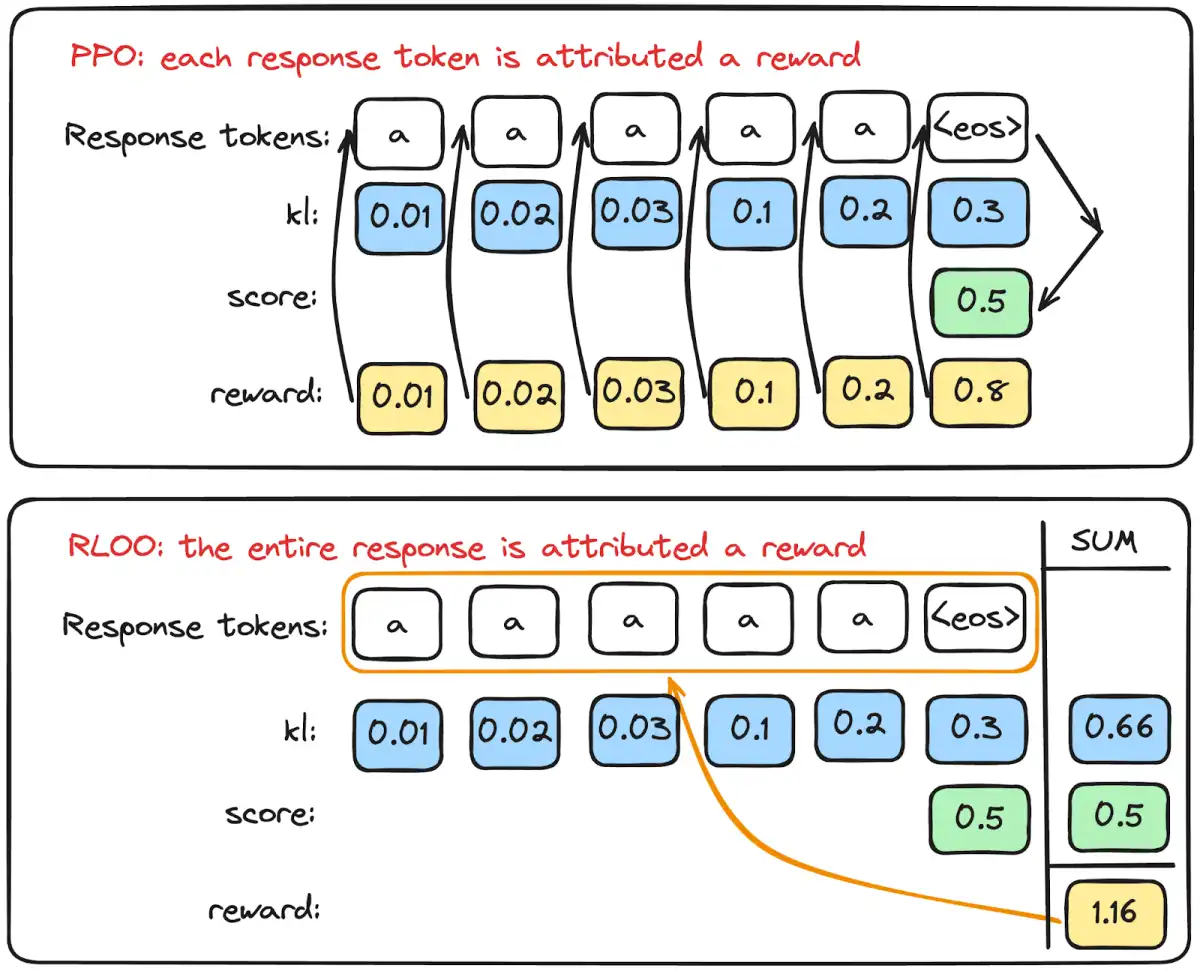
PPO has been widely used in RLHF training due to its effectiveness in optimizing policy performance. However, it requires four copies of the model to be loaded into memory, which can lead to high GPU memory usage and complexity. The RLOO Trainer addresses these issues by modeling the entire completion tokens as a single action, reducing the number of model copies required.
The Hugging Face team notes that online RL is more effective than offline methods like DPO (Direct Preference Optimization). Studies have shown that online RL can achieve better performance and faster convergence times. The RLOO Trainer brings online RL back into RLHF training, enabling researchers to explore this approach with ease.
Why it Matters
The introduction of the RLOO Trainer has significant implications for the industry. With its reduced memory usage and simplified training process, researchers can now focus on exploring online RL methods without being hindered by complexity and resource constraints. This development opens up new possibilities for RLHF training and enables researchers to push the boundaries of what is possible with language models.
The RLOO Trainer also addresses the issue of high computational cost associated with PPO. By reducing the number of model copies required, the RLOO Trainer can run faster and more efficiently, making it an attractive option for researchers who need to train large models quickly.
What Comes Next
The introduction of the RLOO Trainer marks a significant milestone in the development of RLHF training algorithms. As researchers begin to explore this new approach, we can expect to see new breakthroughs and innovations in the field. The Hugging Face team plans to continue developing and refining the RLOO Trainer, making it an essential tool for researchers working on RLHF projects.
Key Facts
- The RLOO Trainer uses approximately 50-70% less vRAM than PPO.
- The RLOO Trainer runs faster than PPO, with a 2x speedup for 1B models and up to 3x speedup for 6.9B models.
- The RLOO Trainer models the entire completion tokens as a single action, reducing the number of model copies required.
- Online RL is more effective than offline methods like DPO (Direct Preference Optimization).
- The RLOO Trainer addresses the issue of high computational cost associated with PPO.
The introduction of the RLOO Trainer marks a significant development in the field of RLHF training. With its reduced memory usage and simplified training process, researchers can now explore online RL methods with ease. As the industry continues to evolve, we can expect to see new breakthroughs and innovations in the field.