The latest advancements in artificial intelligence have brought significant changes to the coding landscape, particularly with the release of GPT-5 by OpenAI. This unified model combines deep reasoning and speed, allowing it to tackle complex tasks with ease. According to various sources, including OpenAI's official materials and developer reviews, GPT-5 has shown impressive capabilities in agentic coding, computer use, knowledge work, and early scientific research.
What Happened
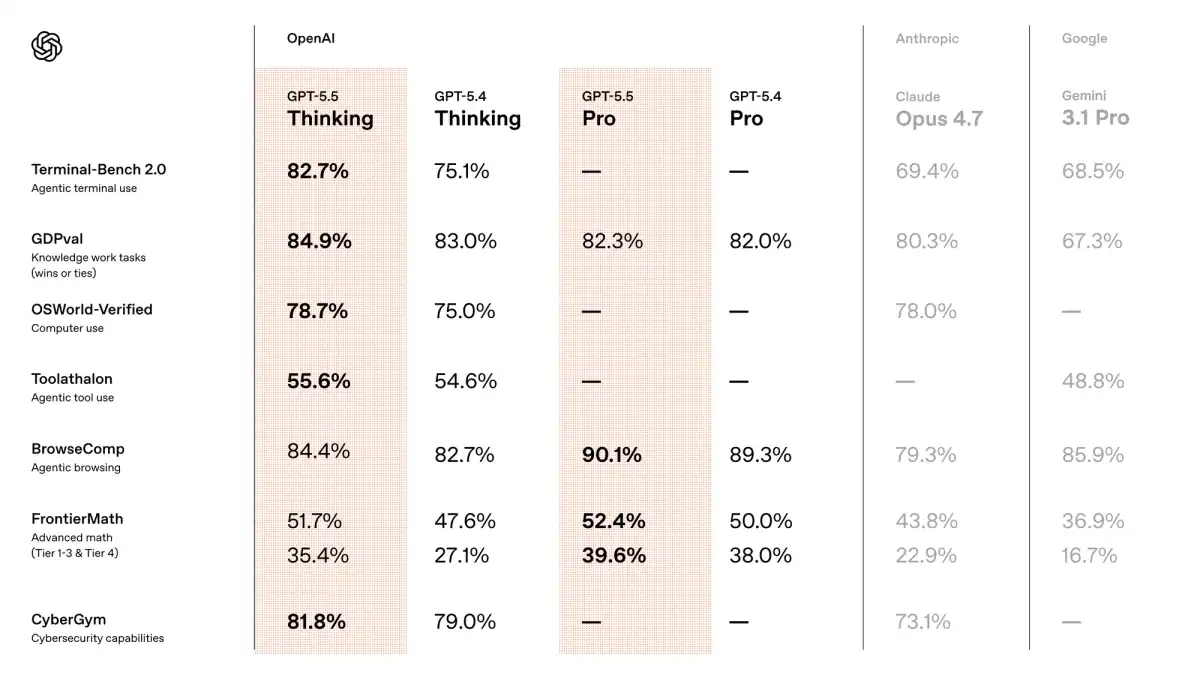
GPT-5 was released by OpenAI on April 23, 2026, with the API being opened quietly the next day. The model's design intent is to reduce prompt engineering and increase autonomous task completion. This is evident in its ability to hold context across large systems, reason through ambiguous failures, and check its own work. OpenAI has highlighted four areas where GPT-5 excels: agentic coding, computer use, knowledge work, and early scientific research.
The model's coding strengths are attributed to three key behaviors that distinguish it from its predecessor, GPT-5.4. These include holding context across large systems, reasoning through ambiguous failures, and checking its own work. OpenAI has published three coding-specific benchmarks where GPT-5 advances over GPT-5.4: Terminal-Bench 2.0, SWE-Bench Pro, and Expert-SWE (internal). In these benchmarks, GPT-5 outperforms GPT-5.4 in complex command-line workflows, real-world GitHub issue resolution, and long-horizon coding tasks.
Background and Context
GPT-5 is the latest iteration of OpenAI's unified model, which combines the deep reasoning smarts of the o-series with the speed and responsiveness of the GPT series. This means that developers no longer have to choose between a "fast" or "smart" model; instead, GPT-5 decides in real-time whether the prompt needs instant output or deeper thinking.
According to OpenAI's internal data point, 85% of the company uses Codex weekly across various functions, including software engineering, finance, communications, marketing, data science, and product management. This suggests that GPT-5 was tuned with in-house adoption claims as a lens through which the model was developed.
Why It Matters to the Industry
The adult industry relies heavily on technology and engineering to deliver high-quality content and services to its users. The advancements brought about by GPT-5 have significant implications for this industry, particularly in terms of scalability, moderation, age-gating, fraud prevention, and privacy.
With GPT-5's ability to handle complex tasks with ease, developers can focus on creating more sophisticated and engaging content. This could lead to improved user experiences, increased revenue streams, and enhanced brand reputation. Additionally, the model's agentic coding capabilities can help reduce the workload of human moderators, allowing them to focus on higher-level tasks.
The industry's reliance on AI-powered tools for moderation, age-gating, and fraud prevention also makes GPT-5 a crucial development. The model's ability to reason through ambiguous failures and check its own work can help improve the accuracy and effectiveness of these systems, reducing the risk of false positives or negatives.
What Comes Next
As GPT-5 continues to evolve and improve, it is likely that we will see significant changes in the way developers approach coding tasks. The model's ability to handle complex tasks with ease will enable developers to focus on more creative and high-level tasks, leading to improved innovation and productivity.
The adult industry can also expect to see increased adoption of GPT-5-powered tools for moderation, age-gating, and fraud prevention. As the model continues to improve, it is likely that we will see even more sophisticated and effective solutions to these challenges.
Key Facts
- GPT-5 was released by OpenAI on April 23, 2026, with the API being opened quietly the next day.
- The model's design intent is to reduce prompt engineering and increase autonomous task completion.
- GPT-5 excels in agentic coding, computer use, knowledge work, and early scientific research.
- OpenAI has published three coding-specific benchmarks where GPT-5 advances over GPT-5.4: Terminal-Bench 2.0, SWE-Bench Pro, and Expert-SWE (internal).
- GPT-5's ability to handle complex tasks with ease can help reduce the workload of human moderators.