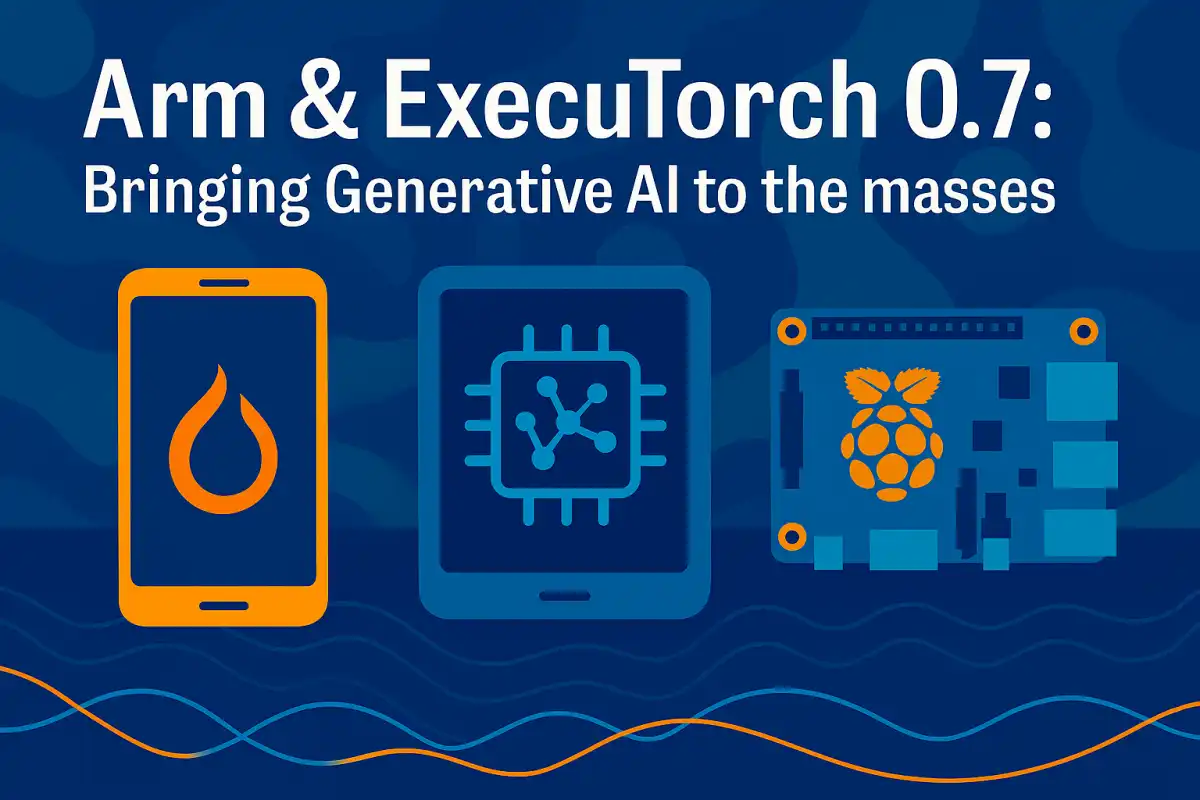
The Arm and ExecuTorch 0.7 update brings significant advancements to Generative AI (GenAI) performance on mobile devices, making it possible for a broader range of hardware to run large language models (LLMs). This development has far-reaching implications for the adult industry, where GenAI is increasingly being used in applications such as content moderation, chatbots, and personalized recommendations.
The update enables KleidiAI by default, delivering automatic acceleration on Arm CPUs with zero integration effort. This means that developers can now access KleidiAI's AI performance optimizations via ExecuTorch and XNNPack without requiring custom tuning or code changes. The result is faster model startups, lower latency, leaner memory footprints, and no integration hurdles.
Background and Context
The recent Arm SME2 announcement highlighted the growing role of Arm KleidiAI as the AI acceleration layer powering the next wave of AI on Arm. By embedding into widely-used Edge AI frameworks like XNNPack, MediaPipe, MNN, ONNX Runtime, and even llama.cpp, KleidiAI has delivered substantial performance improvements with no code changes required by developers.
This foundation leads directly to the upcoming ExecuTorch 0.7 beta, where KleidiAI will be enabled by default—bringing automatic acceleration to devices built on the latest Arm CPU architecture, as well as a vast base of existing phones built on earlier generations. Android and cross-platform developers—whether first- or third-party—gain instant access to KleidiAI AI performance optimizations via ExecuTorch and XNNPack.
Why it Matters to the Industry
The ability to run GenAI experiences like LLMs on a broader range of hardware has significant implications for the adult industry. With this update, developers can now bring GenAI capabilities to devices that are 3, 4, or even 5 years old, or even to the Raspberry Pi 5. This means that content creators and platform operators can leverage GenAI in applications such as content moderation, chatbots, and personalized recommendations without requiring high-end hardware.
The use of SDOT (Signed Dot Product) instruction, introduced in the Armv8.2 architecture and later CPUs, enables efficient dot product operations on vectors of 8-bit signed integers. This instruction can be utilized to accelerate matrix multiplication routines—the core computational workload behind every LLM—when using Int8 or lower-bit precision formats, such as Int4.
What Comes Next
The Arm and ExecuTorch 0.7 update opens up new possibilities for the adult industry, enabling developers to create more sophisticated GenAI-powered applications without requiring high-end hardware. The combined power of SDOT, KleidiAI, and ExecuTorch is pushing the boundaries of what is possible, making it accessible on billions of Arm-based devices already in use.
Arm's learning path, designed to guide developers through developing their own applications with LLMs using ExecuTorch and KleidiAI, will be a valuable resource for those looking to leverage this technology. The update also highlights the importance of collaboration between industry leaders, as seen in the partnership between Arm and Meta.
Key Facts
- ExecuTorch 0.7 now enables KleidiAI by default, delivering automatic acceleration on Arm CPUs with zero integration effort.
- GenAI is now performant on millions of existing devices—including 3–5 year-old smartphones and Raspberry Pi 5—thanks to Arm CPU features like SDOT and I8MM.
- On-device use cases like private voice assistants, message summarization, and local code/gen AI copilots are now possible—without the cloud, and without the battery drain.
- The SDOT instruction is already widely supported across a diverse range of devices, opening the door for GenAI use cases to reach a significantly larger smartphone audience.
- Approximately 3 billion Arm-based devices include this capability, enabling powerful on-device GenAI experiences for the majority of users.
The Arm and ExecuTorch 0.7 update marks an exciting milestone in the development of GenAI on mobile devices. As the adult industry continues to leverage this technology, it will be interesting to see how developers and platform operators adapt to these new possibilities.