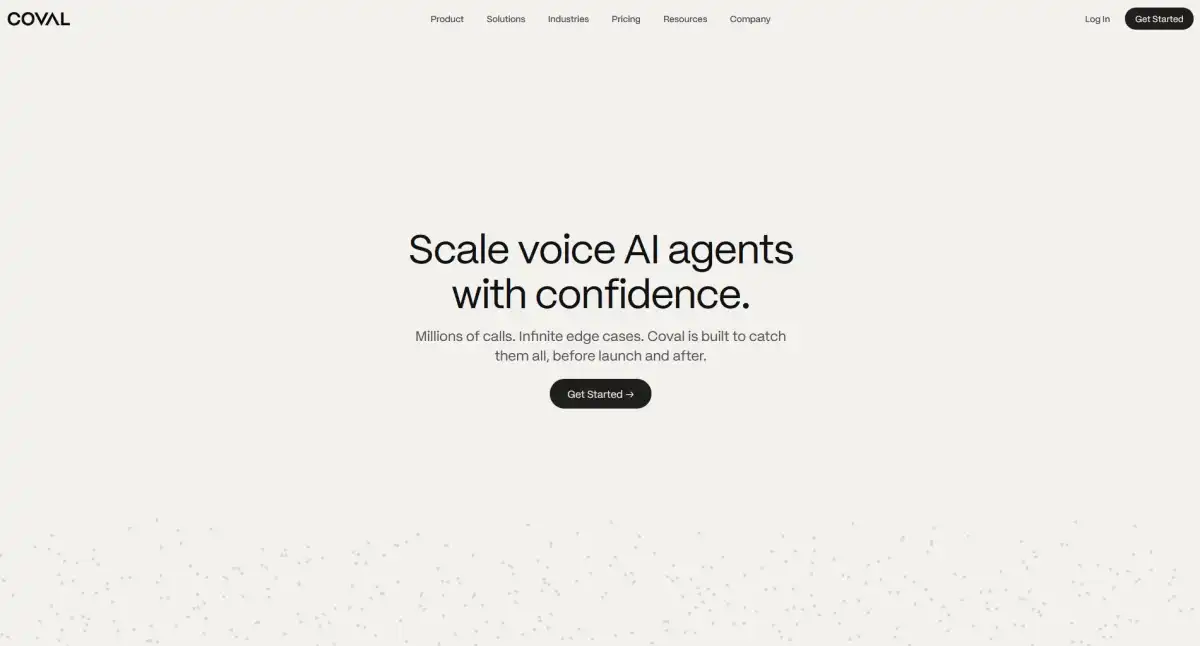
Coval, a San Francisco-based startup founded by Brooke Hopkins, has raised $28 million in Series A funding to expand its platform for testing and evaluating voice AI agents. The company's technology draws on principles commonly used in autonomous vehicle development, treating conversational agents as autonomous systems that must be tested across a wide range of scenarios before interacting with customers.
The investment brings Coval's total funding to $31 million since its launch in 2024. The round was led by Norwest and included participation from Base10 Partners, Twilio Ventures, and Y Combinator. Coval's platform is designed to help enterprises deploy voice and chat AI systems with greater reliability, observability, and compliance oversight.
Background and Context
Coval's founder, Brooke Hopkins, has a background in autonomous vehicle development. She previously led evaluation infrastructure at Waymo, Alphabet's self-driving car unit, where simulation and testing frameworks played a central role in validating self-driving systems before deployment. Coval applies a similar methodology to voice AI, treating conversational agents as autonomous systems that must be tested across a wide range of scenarios before interacting with customers.
The company's technology is designed to address the challenges of deploying voice AI agents at scale. Many organizations continue to rely on manual quality assurance processes that were designed for traditional software environments rather than autonomous systems capable of handling millions of conversations. Coval's platform is designed to test AI agents before deployment and continuously assess performance after launch.
Why it Matters to the Industry
The investment in Coval comes amid rapid growth in the broader voice AI market. Industry investment in voice AI surpassed $7 billion during the first quarter of 2026 alone, as enterprises increasingly look to automate customer interactions through conversational AI systems. However, many organizations continue to struggle with ensuring that their voice AI agents perform consistently in production environments.
Coval's platform is designed to address this challenge by providing a comprehensive evaluation tool for voice AI agents. The company's technology includes simulation, monitoring, and evaluation tools that allow businesses to test AI agents before deployment and continuously assess performance after launch. This approach has already shown promise, with over 60 organizations using Coval's platform, including Zoom Communications and Deepgram.
What Comes Next
The new capital will be used to expand Coval's sales and solutions engineering teams while accelerating product development. Planned investments include enhanced simulation capabilities, deeper integrations with voice AI ecosystems, and expanded human review and monitoring features. The company is targeting one of the sector's most pressing challenges: ensuring AI-powered conversations perform consistently in production environments.
Coval's founder, Brooke Hopkins, believes that every company will eventually have a voice agent just like they have a mobile app or a web app. However, many organizations continue to struggle with deploying voice AI agents at scale due to the complexity of testing and evaluating these systems. Coval's platform is designed to address this challenge by providing a comprehensive evaluation tool for voice AI agents.
Key Facts
- Coval has raised $28 million in Series A funding, bringing its total funding to $31 million since its launch in 2024.
- The round was led by Norwest and included participation from Base10 Partners, Twilio Ventures, and Y Combinator.
- Coval's platform is designed to help enterprises deploy voice and chat AI systems with greater reliability, observability, and compliance oversight.
- The company's technology draws on principles commonly used in autonomous vehicle development.
- Over 60 organizations are using Coval's platform, including Zoom Communications and Deepgram.
Coval's investment is a significant vote of confidence in the company's ability to address one of the sector's most pressing challenges: ensuring AI-powered conversations perform consistently in production environments. As the voice AI market continues to grow, it will be interesting to see how Coval's platform evolves and whether it can help enterprises deploy voice AI agents at scale.