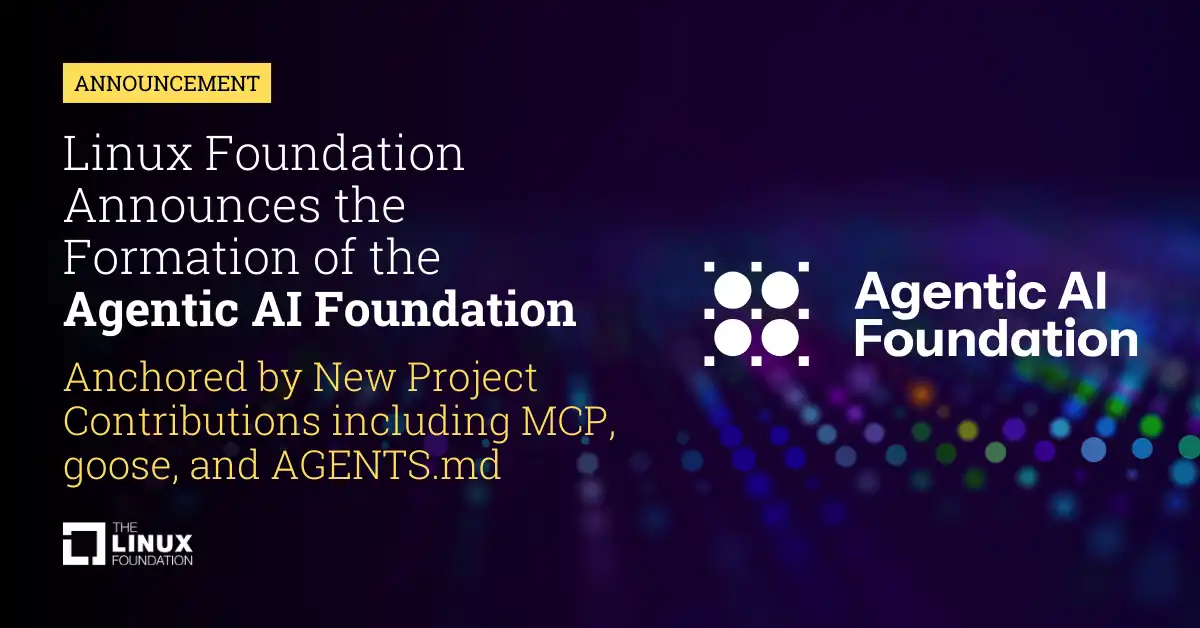
The Agentic AI Foundation (AAIF) has been established as a neutral, open foundation to ensure the evolution of agentic AI technology in a transparent and collaborative manner. The AAIF was formed by the Linux Foundation, with founding contributions from leading technical projects including Anthropic's Model Context Protocol (MCP), Block's goose, and OpenAI's AGENTS.md.
The advent of agentic AI represents a new era of autonomous decision making and coordination across AI systems that will transform and revolutionize entire industries. The AAIF provides a platform for the development of open source AI projects, ensuring that this critical capability evolves in ways that advance the adoption of leading open source AI projects.
What Happened
The Linux Foundation announced the formation of the Agentic AI Foundation (AAIF) on December 9, 2025. The AAIF is anchored by new project contributions from Anthropic, Block, and OpenAI, including Model Context Protocol (MCP), goose, and AGENTS.md. These projects lay the groundwork for a shared ecosystem of tools, standards, and community-driven innovation.
The founding members of the AAIF include Amazon Web Services, Anthropic, Block, Bloomberg, Cloudflare, Google, Microsoft, and OpenAI. The AAIF provides a neutral, open foundation to ensure agentic AI evolves transparently and collaboratively.
Background and Context
Agentic AI represents a new era of autonomous decision making and coordination across AI systems. This technology has the potential to transform and revolutionize entire industries. The AAIF provides a platform for the development of open source AI projects, ensuring that this critical capability evolves in ways that advance the adoption of leading open source AI projects.
The Model Context Protocol (MCP) is a universal standard protocol for connecting AI models to tools, data, and applications. Goose is an open-source, local-first AI agent framework that combines language models, extensible tools, and standardized MCP-based integration. AGENTS.md is a simple, universal standard that gives AI coding agents a consistent source of project-specific guidance needed to operate reliably across different repositories and toolchains.
Why it Matters
The establishment of the AAIF has significant implications for the industry. The AAIF provides a platform for the development of open source AI projects, ensuring that agentic AI technology evolves in ways that advance the adoption of leading open source AI projects. This will enable the creation of more sophisticated and autonomous AI systems that can work together to achieve complex tasks.
The AAIF also provides a neutral, open foundation for the development of agentic AI technology. This ensures that the evolution of this critical capability is transparent and collaborative, rather than being controlled by any single entity or interest group.
What Comes Next
The AAIF has launched several initiatives to advance the development of agentic AI technology. These include the Skills Over MCP working group, which aims to develop a standard for shipping agent instructions alongside tools exposed by MCP servers. This will enable agents to operate more reliably and effectively across different repositories and toolchains.
Key Facts
- The Agentic AI Foundation (AAIF) has been established as a neutral, open foundation to ensure the evolution of agentic AI technology in a transparent and collaborative manner.
- The AAIF was formed by the Linux Foundation, with founding contributions from leading technical projects including Anthropic's Model Context Protocol (MCP), Block's goose, and OpenAI's AGENTS.md.
- The AAIF provides a platform for the development of open source AI projects, ensuring that agentic AI technology evolves in ways that advance the adoption of leading open source AI projects.
- The founding members of the AAIF include Amazon Web Services, Anthropic, Block, Bloomberg, Cloudflare, Google, Microsoft, and OpenAI.
- The AAIF has launched several initiatives to advance the development of agentic AI technology, including the Skills Over MCP working group.