Preview · this article is in the editorial review queue and is not yet approved for publish.
Review & approve →
Explore how finetuned reranker models, using Sentence Transformers, improve search systems' performance. Learn about the training components.
Finetuning Reranker Models: A Game-Changer for Search and Retrieval
The landscape of search and retrieval has undergone a significant shift with the introduction of finetuned reranker models. These models have been shown to outperform existing general-purpose rerankers on specific datasets, making them a crucial component in building efficient and effective search systems. In this article, we will delve into the world of finetuning reranker models using
Sentence Transformers and explore their potential applications.
What are Reranker Models?
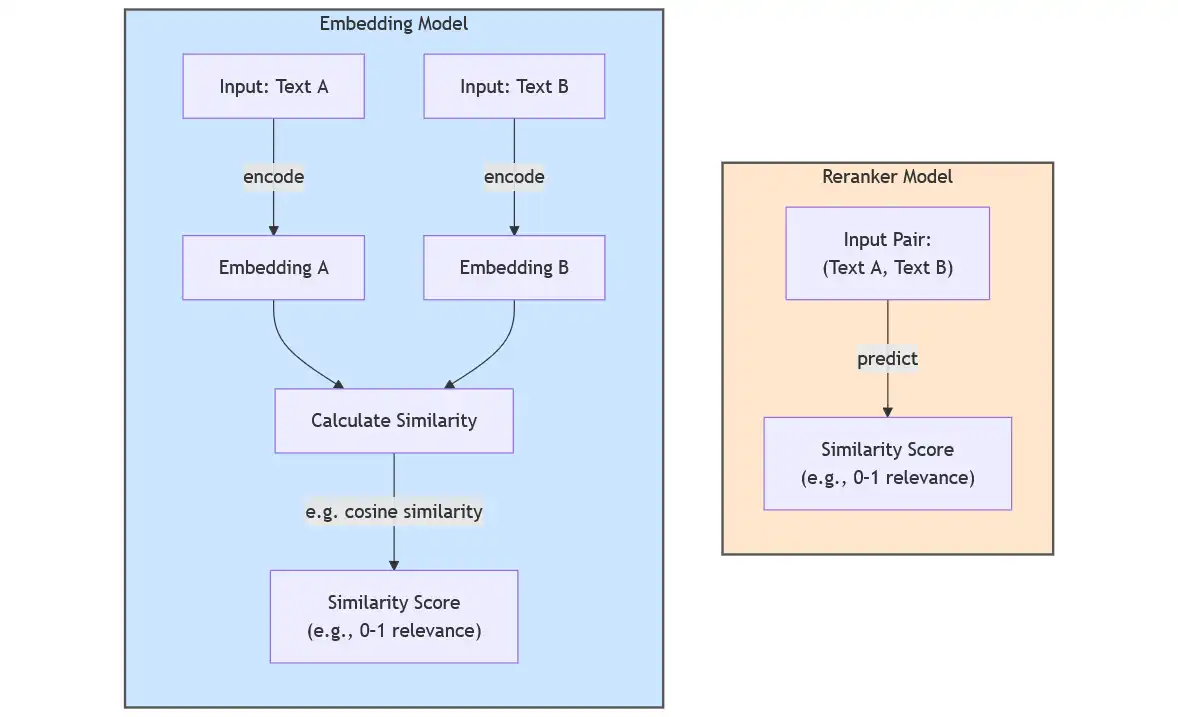
Reranker models, also known as cross-encoder architectures, are designed to evaluate the relevance between pairs of texts. Unlike bi-encoders (embedding models), which independently embed each text into vectors and compute similarity via a distance metric, cross-encoders process the paired texts together through a shared neural network, resulting in one output score. This architecture allows reranker models to capture complex relationships between texts, making them particularly effective in search and retrieval applications.
Why Finetune?
Finetuning reranker models is essential for several reasons. Firstly, it enables the model to adapt to specific datasets and tasks, leading to improved performance. Secondly, finetuning allows developers to leverage pre-trained models as a starting point, reducing the need for extensive training from scratch. Finally, finetuning provides an efficient way to update existing models to keep pace with evolving data distributions.
Training Components
Finetuning reranker models involves several key components: datasets, loss functions, training arguments, evaluators, and the trainer class itself. Each of these components plays a crucial role in determining the model's performance.
* **Dataset**: The dataset used for finetuning should be relevant to the specific task or application. In this case, we will use the GooAQ dataset, which consists of pairs of texts with relevance labels.
* **Loss Function**: The loss function determines how the model is optimized during training. For reranker models, the MultipleNegativesRankingLoss (MNRL) is often used, as it treats other samples in the batch as negative examples.
* **Training Arguments**: Training arguments control various aspects of the training process, such as the number of epochs, batch size, and learning rate.
* **Evaluator**: The evaluator assesses the model's performance during and after training. In this case, we will use the CrossEncoderRerankingEvaluator with GooAQ mined negatives.
Key Facts
Here are some key facts about finetuning reranker models:
- Finetuning reranker models can significantly improve their performance on specific datasets.
- Reranker models can be finetuned using pre-trained models as a starting point, reducing the need for extensive training from scratch.
- The MultipleNegativesRankingLoss (MNRL) is often used as the loss function for reranker models.
- Finetuning reranker models requires careful selection of datasets, loss functions, and training arguments to achieve optimal performance.
- Reranker models can be evaluated using metrics such as NDCG@10 and MAP.
Conclusion
Finetuning reranker models has emerged as a crucial component in building efficient and effective search systems. By leveraging pre-trained models, adapting to specific datasets, and optimizing training parameters, developers can create high-performance rerankers that outperform existing general-purpose models. As the field of natural language processing continues to evolve, finetuning reranker models will play an increasingly important role in driving innovation and improvement.
Additional Resources
For further learning, you may also want to explore the following resources on Sentence Transformers:
*
Training Overview
*
Training and Finetuning Reranker Models with Sentence Transformers
These resources provide detailed information on training reranker models, including datasets, loss functions, training arguments, evaluators, and the trainer class itself. By following these guidelines and leveraging the power of finetuned rerankers, developers can unlock new possibilities in search and retrieval applications.