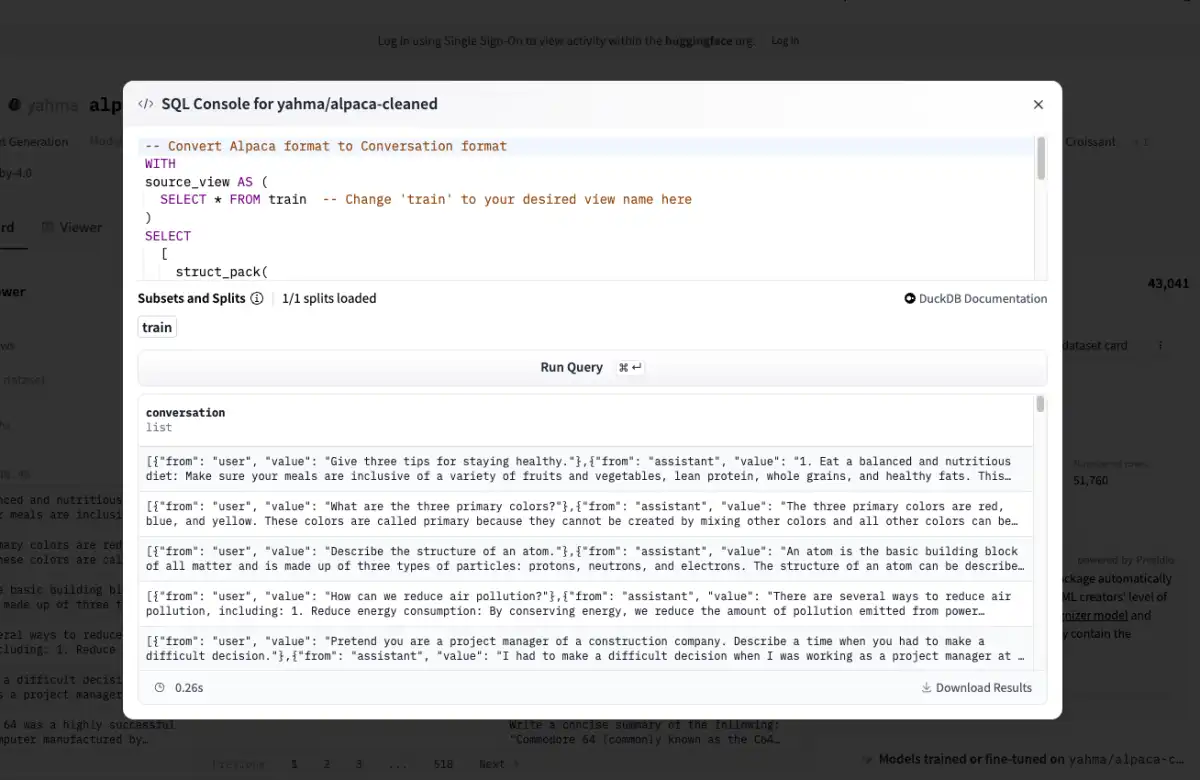
Hugging Face has introduced a powerful new SQL Console feature for datasets, enabling users to directly query and analyze data within their web browser. The SQL Console leverages DuckDB WASM technology, allowing users to perform complex queries without any backend dependencies or setup requirements.
What Happened
The SQL Console is now available for all public datasets on the Hugging Face Hub, accessible via a dedicated badge on each dataset page. This tool provides several advantages for data scientists and researchers working with datasets on the Hugging Face platform. Queries are executed entirely locally in the browser, ensuring data privacy and eliminating the need for server-side processing.
The console supports full DuckDB syntax, which is similar to PostgreSQL, providing a wide range of capabilities for data manipulation and analysis. Users can export query results to Parquet format for further analysis or integration with other tools. The console also provides shareable links for query results on public datasets, facilitating collaboration and reproducibility.
Background and Context
Datasets use has been exploding and Hugging Face has become the default home for many datasets. Each month, as the amount of datasets uploaded to the Hub increases, so does the need to query, filter, and discover them. The SQL Console is a fundamental shift in how we interact with open-source data, allowing users to fire up a fully functional SQL environment on any of the 150,000+ public datasets hosted on the Hub.
The secret sauce behind the SQL Console is the file format. Hugging Face automatically converts datasets to Parquet, a columnar storage format optimized for performance and storage efficiency. When you run a query like SELECT column_a FROM table, DuckDB doesn't read the whole file. It uses HTTP Range requests to fetch only the chunks corresponding to column_a, making the SQL Console incredibly bandwidth-efficient.
Why it Matters to the Industry
The introduction of the SQL Console has significant implications for the adult industry. With the ability to execute complex queries directly in the browser, developers can streamline data extraction and analysis processes, saving time and resources. The console's support for full DuckDB syntax provides a wide range of capabilities for data manipulation and analysis, making it an ideal tool for data scientists working with large amounts of data.
The SQL Console also enables quick filtering and aggregation of data, allowing developers to identify patterns and trends in their datasets more efficiently. This can lead to improved model performance, better decision-making, and increased revenue. Additionally, the console's shareable links facilitate collaboration and reproducibility, making it easier for teams to work together on complex projects.
What Comes Next
The SQL Console is a powerful tool that has the potential to revolutionize dataset exploration on Hugging Face. As the platform continues to evolve, we can expect to see more features and capabilities added to the console. The introduction of the SQL Console also highlights the importance of data privacy and security in the adult industry.
Developers should be aware of the limitations of the console, including a memory limit of approximately 3GB, which may affect processing for extremely large or complex queries. However, with careful planning and optimization, developers can overcome these limitations and unlock the full potential of the SQL Console.
Key Facts
- The SQL Console is now available for all public datasets on the Hugging Face Hub.
- The console leverages DuckDB WASM technology to execute complex queries locally in the browser.
- The console supports full DuckDB syntax, similar to PostgreSQL.
- Users can export query results to Parquet format for further analysis or integration with other tools.
- The console provides shareable links for query results on public datasets, facilitating collaboration and reproducibility.
- The memory limit of the console is approximately 3GB.