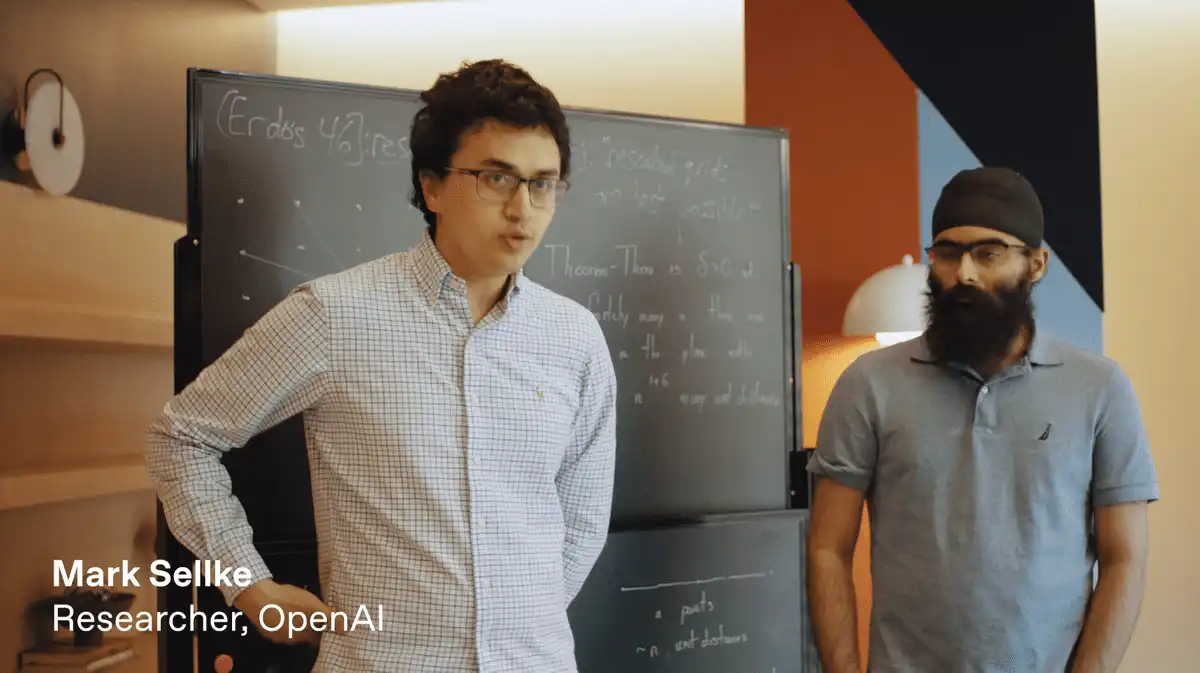
An OpenAI model has made a groundbreaking discovery in discrete geometry, disproving a central conjecture that had remained unsolved for nearly 80 years. The unit distance problem, posed by mathematician Paul Erdős in 1946, asks how many pairs of points can be exactly distance 1 apart when n points are placed in the plane. OpenAI's model has found an example with more than unit distances, marking a significant breakthrough in combinatorial geometry.
Background and Context
The unit distance problem is one of the best-known questions in combinatorial geometry, easy to state but remarkably difficult to resolve. Erdős even offered a monetary prize for resolving this problem, which has been studied by mathematicians for nearly eight decades. The problem's simplicity belies its complexity, and it has been the subject of much research and debate.
OpenAI's model is an internal AI system that uses large language models to search for mathematical discoveries. This approach has already yielded impressive results, including the completion of doctoral-level research in just one hour using ChatGPT 5.5 Pro. The model's ability to tackle complex mathematical problems has sparked excitement among mathematicians and computer scientists alike.
What Happened
The breakthrough was announced by OpenAI on May 20, 2026, with a technical paper detailing the proof presented in the Remarks on the disproof of the unit distance conjecture. The paper is authored by Alon, Bloom, Gowers, Litt, Sawin, Shankar, Tsimerman, Wang, and Matchett Wood, who explain how their internal model used algebraic number theory to find an example with more than unit distances.
The proof relies on a combination of mathematical techniques, including the use of large language models to search for solutions. The authors note that their approach is novel and builds upon previous results in the field. The paper has been widely praised by mathematicians and computer scientists, who recognize the significance of this breakthrough.
Why it Matters
The implications of OpenAI's discovery are far-reaching and significant for the mathematical community. The unit distance problem is a fundamental question in combinatorial geometry, and its resolution has important consequences for our understanding of spatial relationships and distances. This breakthrough also highlights the potential of large language models to tackle complex mathematical problems.
For the adult industry, this development may seem tangential at first glance. However, it speaks to the growing importance of AI and machine learning in tackling complex computational challenges. As platforms and operators continue to grapple with issues like latency, scale, moderation, age-gating, fraud, and privacy, they will increasingly rely on innovative technologies like large language models.
What Comes Next
The OpenAI model's success has sparked excitement among mathematicians and computer scientists. Researchers are already exploring new applications of this technology, including its potential to tackle other long-standing mathematical problems. The development of more advanced AI systems will continue to push the boundaries of what is possible in mathematics and beyond.
Key Facts
- The unit distance problem has been unsolved for nearly 80 years, despite being one of the best-known questions in combinatorial geometry.
- OpenAI's internal model used algebraic number theory to find an example with more than unit distances.
- The proof relies on a combination of mathematical techniques, including the use of large language models to search for solutions.
- The authors note that their approach is novel and builds upon previous results in the field.
- ChatGPT 5.5 Pro completed doctoral-level research in just one hour using OpenAI's model.
- The breakthrough has sparked excitement among mathematicians and computer scientists, who recognize its significance for mathematics and beyond.