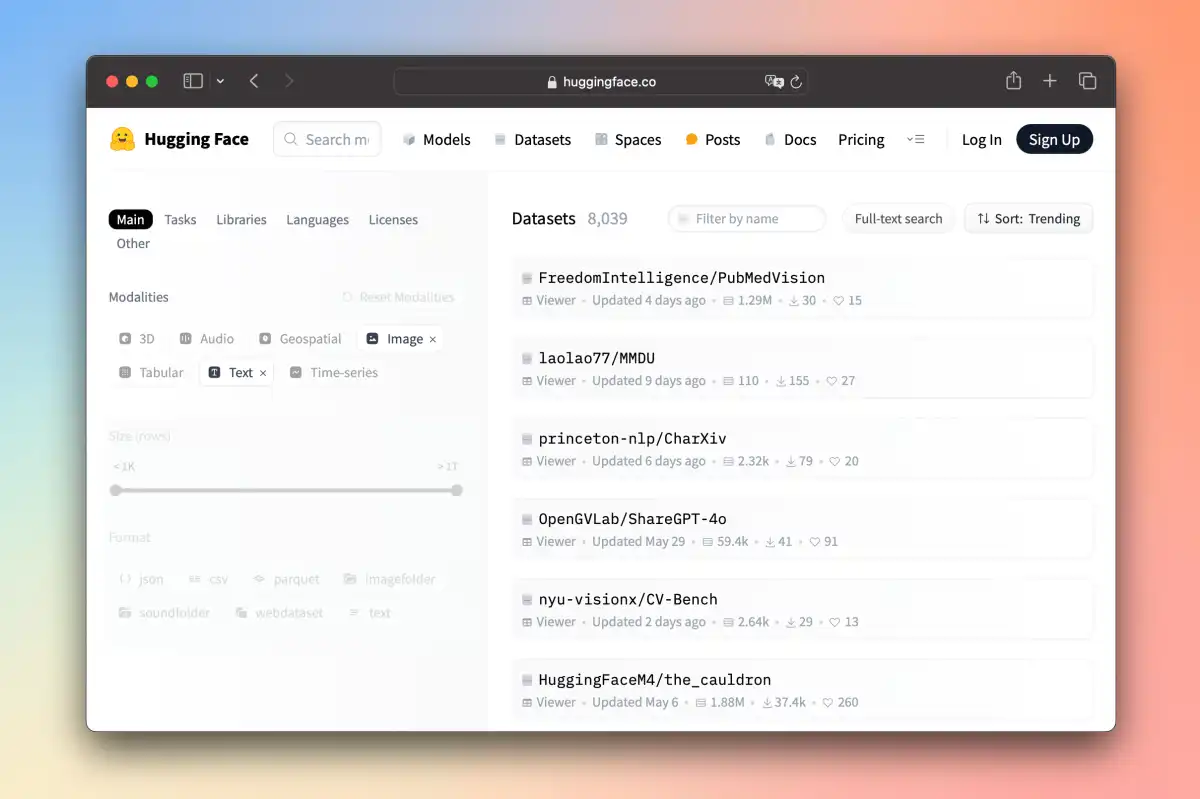
The Hugging Face Dataset Hub has announced four new features for its Dataset Search tool, aimed at improving discoverability and visualization of public datasets. The updates include search by modality, size, format, and library, as well as the ability to combine filters.
What Happened
The Hugging Face Dataset Hub has been a central platform for the AI and ML community to share and collaborate on open datasets. With over 180,000 public datasets available, researchers and engineers rely on these datasets for various tasks, from training LLMs to chat with users to evaluating automatic speech recognition or computer vision systems. However, dataset discoverability and visualization have been key challenges in letting AI builders find, explore, and transform datasets to fit their use cases.
To address this issue, the Hugging Face team has introduced four new features for its Dataset Search tool: search by modality, size, format, and library. These updates aim to make it easier for users to find relevant datasets based on specific criteria, such as the type of data (modality), dataset size, storage format, or compatibility with their preferred libraries.
Background and Context
Dataset Search is not a new concept; Google has been working on its own Dataset Search tool since 2018. In fact, a Dataverse Users Community thread from September 2018 discussed how to reference Dataverse datasets in the Google Dataset Search engine. However, it seems that Hugging Face's Dataset Hub has taken a different approach by introducing its own set of filters and features.
Google's Dataset Search tool has indexed almost 25 million datasets across the web, providing users with a single place to search for datasets and find links to where the data is. The tool has been in beta since 2019 but has recently come out of beta after receiving feedback from early adopters. Some new features include filtering results based on dataset types, availability, and geographic areas.
Why it Matters
The updates to Hugging Face's Dataset Search tool have significant implications for the adult industry, particularly in terms of data management and discovery. With the ability to search by modality, size, format, and library, users can now find relevant datasets more efficiently. This is crucial for AI-powered applications, such as chatbots or content moderation tools, which rely on high-quality datasets to function effectively.
Moreover, the introduction of these features highlights the growing importance of dataset discoverability in the AI community. As the demand for high-quality datasets continues to rise, platforms like Hugging Face's Dataset Hub will play a vital role in facilitating collaboration and innovation within the industry.
What Comes Next
The future of dataset search and discovery is exciting, with both Google and Hugging Face pushing the boundaries of what is possible. As the adult industry continues to adopt AI-powered solutions, it's essential to stay up-to-date with the latest developments in dataset management and discovery.
Key Facts
- The Hugging Face Dataset Hub has over 180,000 public datasets available for use.
- Hugging Face's Dataset Search tool now includes four new features: search by modality, size, format, and library.
- Google's Dataset Search tool has indexed almost 25 million datasets across the web.
- The Hugging Face team aims to make dataset discoverability and visualization easier for AI builders.
- The updates to Hugging Face's Dataset Search tool have significant implications for the adult industry, particularly in terms of data management and discovery.