A massive security breach has compromised at least 18 popular JavaScript code packages on the Node Package Manager (NPM), a central hub for JavaScript development and updates. The attack, which was quickly contained, appears to have been narrowly focused on stealing cryptocurrency, but experts warn that similar attacks with more nefarious payloads could lead to devastating malware outbreaks.
What Happened
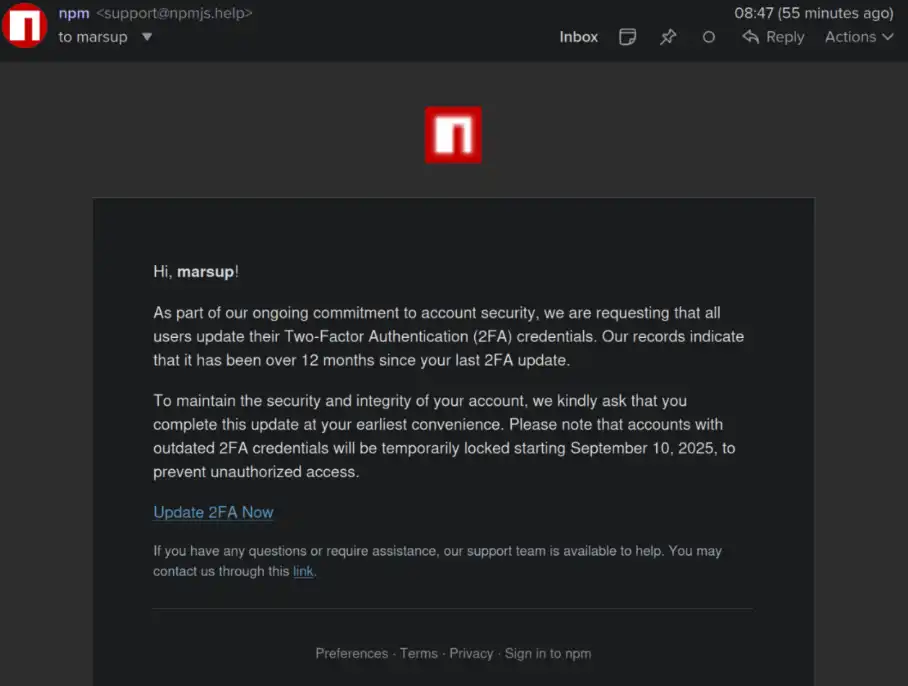
A developer involved in maintaining the projects was phished by a fake NPM website, tricked into logging in and supplying a one-time token for two-factor authentication. The attackers then used the compromised account to add malicious code to at least 18 popular JavaScript code packages.
The security firm Aikido, which monitors new code updates to major open-source code repositories, detected the malicious code and notified the affected developer, Josh Junon. Junon quickly replied that he was aware of having just been phished and began cleaning up the compromised packages.
Aikido's systems found that the attackers had injected a piece of code that silently intercepts cryptocurrency activity in the browser, manipulates wallet interactions, and rewrites payment destinations to redirect funds to attacker-controlled accounts without any obvious signs to the user. This malware is essentially a browser-based interceptor that hijacks both network traffic and application APIs.
Background and Context
JavaScript is a powerful web-based scripting language used by countless websites to build interactive experiences for users, such as entering data into forms. However, with great power comes great responsibility, and the use of pre-existing code packages on NPM can introduce security risks if not properly vetted.
NPM acts as a central hub for JavaScript development and updates, making it a prime target for attackers seeking to compromise widely-used code libraries. If cybercriminals manage to phish NPM credentials from developers, they can introduce malicious code that allows attackers to fundamentally control what people see in their web browser when visiting a website that uses one of the affected code libraries.
Aikido's researcher Charlie Eriksen explained that the attackers' goal was not to steal sensitive data but rather to intercept cryptocurrency activity and redirect funds to attacker-controlled accounts. This type of attack is particularly concerning because it operates at multiple layers, altering content shown on websites, tampering with API calls, and manipulating what users' apps believe they are signing.
Why It Matters to the Industry
The compromise of these 18 popular code packages highlights the importance of robust security measures in the adult industry. With billions of downloads per week, NPM is a critical infrastructure component that requires secure authentication and authorization protocols to prevent similar attacks in the future.
Experts warn that similar attacks with more nefarious payloads could lead to devastating malware outbreaks that are difficult to detect and restrain. The use of phish-proof authentication methods, such as physical security keys, is essential for protecting against these types of attacks.
Nicholas Weaver, a researcher at the International Computer Science Institute, emphasized that many organizations are still one successful phishing attack away from a supply-chain nightmare. He urged NPM to adopt phish-proof authentication methods and highlighted the need for code repository compromises to be addressed promptly to prevent devastating consequences for developers and their projects.
What Comes Next
Aikido has launched a product aimed at helping development teams ensure that every code library used is checked for malware before it can be used or installed. This initiative underscores the need for more robust security measures in the industry, particularly in the wake of this massive breach.
Experts warn that similar attacks will continue as long as people responsible for maintaining widely-used code continue to rely on phishable forms of two-factor authentication. The use of physical security keys and other phish-proof authentication methods is essential for protecting against these types of attacks.
Key Facts
- At least 18 popular JavaScript code packages were compromised with malicious software.
- The attack was quickly contained, but experts warn that similar attacks could lead to devastating malware outbreaks.
- The attackers injected a piece of code that silently intercepts cryptocurrency activity in the browser.
- The malware is essentially a browser-based interceptor that hijacks both network traffic and application APIs.
- Aikido detected the malicious code and notified the affected developer, Josh Junon.
- NPM should adopt phish-proof authentication methods to prevent similar attacks in the future.